
Let’s be honest: the promise of the AI contact center was supposed to be a dream. We were told it would offer lightning-fast responses, 24/7 availability, and a dramatic drop in operational costs. But for many businesses, the reality has felt more like a tech-heavy headache.
Instead of seamless resolutions, customers are getting trapped in infinite loops. Instead of happy agents, we have teams frustrated by clunky tools. If your contact center AI feels more like a barrier than a bridge, you aren’t alone. In fact, nearly 85% of AI deployments in the customer service space struggle to meet their initial goals.
So, why is your AI tripping over its own feet? And more importantly, how do we fix it? Let’s dive into the ten biggest reasons your AI strategy might be stalling and how Vsynergize can help you turn the tide.
- No Clear Business Goals or ROI Metrics
- Poor Data Quality and Siloed Systems
- The “Uncanny Valley” of Tone and Sentiment
- Clunky Human Handoffs
- Legacy System Integration Barriers
- The “Fear Factor” and Agent Resistance
- Latency and Performance Issues at Scale
- Weak Intent Models (Misrouting)
- Data Privacy and Security Vulnerabilities
- Lack of Continuous Training
- How Vsynergize Fixes the “Broken AI” Problem
- Stop Troubleshooting and Start Transforming

1. No Clear Business Goals or ROI Metrics
One of the most common reasons an AI contact center fails is that it was launched without a compass. Many companies implement AI because it’s the “hot new thing,” but they haven’t defined what success actually looks like. Did you know that 41% of contact centers can’t actually define the ROI of their AI tools?
The Fix: Before you write another line of code or sign another vendor contract, establish specific KPIs. Are you trying to reduce average wait times by 15%? Or are you aiming for a 10-point jump in first-call resolution? Without measurable targets, your project is just a digital paperweight.
2. Poor Data Quality and Siloed Systems
AI is only as smart as the data you feed it. If your customer data is scattered across legacy CRMs, spreadsheets, and disconnected databases, your AI will be confused. Inconsistent data entry is the silent killer of contact center AI.
The Fix: Prioritize a “data cleanup” phase. You cannot scale AI on a foundation of messy data. Invest in centralizing your customer information so your AI has a “single source of truth” to pull from.

3. The “Uncanny Valley” of Tone and Sentiment
Have you ever been frustrated with a company, only for a chatbot to respond with a bubbly, “I’m so happy to help you today!  “? It feels tone-deaf. Poor sentiment understanding is a major friction point. If the AI can’t tell the difference between a curious prospect and an angry long-term customer, it’s going to fail.
The Fix: You need advanced Natural Language Processing (NLP). Your AI should be able to detect frustration and adjust its tone: or better yet, immediately escalate the call to a human. Understanding the nuances of human emotion is what separates a basic bot from a world-class AI contact center.
4. Clunky Human Handoffs
There is nothing customers hate more than explaining their problem to a bot, only to have to repeat the entire story once they finally reach a human agent. This “start over” syndrome is a symptom of a broken handoff process.
The Fix: Implement seamless context transfers. When a bot passes a call to an agent, the agent should already have a summary of the interaction on their screen. At Vsynergize, we call this the “People+AI” model. The AI does the heavy lifting, but the human is always briefed and ready to take the baton without missing a beat.
5. Legacy System Integration Barriers
Older contact center infrastructure wasn’t built for the cloud-native world of modern AI. Trying to bolt a sophisticated AI onto a 15-year-old legacy system often results in high latency, crashes, and “cascading failures” where one small error brings down the whole system.
The Fix: You don’t necessarily need to rip and replace everything at once. Start with pilot programs that focus on a single use case: like AI for outbound contact centers: and ensure your middleware can bridge the gap between old and new.
6. The “Fear Factor” and Agent Resistance
If your agents think the AI is there to replace them, they won’t use it. They might even find workarounds to bypass it. This lack of “buy-in” from the frontline is a major reason why internal AI tools fail to gain traction.
The Fix: Position AI as an “Agent Assist” tool, not a replacement. Show your team how it handles the boring, repetitive tasks so they can focus on complex, rewarding problem-solving. When agents see AI as their “superpower,” adoption skyrockets.

7. Latency and Performance Issues at Scale
In a live conversation, a three-second delay feels like an eternity. If your contact center AI lags during peak hours, it disrupts the flow of conversation and frustrates the customer. This is usually caused by insufficient real-time infrastructure.
The Fix: Test your systems under realistic traffic loads: not just controlled, low-volume environments. Your infrastructure needs to be robust enough to handle the 2 PM rush as easily as the 2 AM trickle.
8. Weak Intent Models (Misrouting)
If a customer says, “I want to cancel my flight,” and the AI routes them to “New Bookings,” you have an intent mapping problem. Misrouting leads to longer handle times and higher repeat contact rates, which is the exact opposite of what an AI contact center should achieve.
The Fix: Develop robust intent models trained on diverse, real-world customer scenarios. Don’t just program for the “happy path.” Program for the weird, the wordy, and the confused queries.
9. Data Privacy and Security Vulnerabilities
Every customer interaction involves sensitive info. If your AI isn’t compliant with SOC2, GDPR, or HIPAA (depending on your industry), you are sitting on a ticking time bomb of regulatory fines and lost trust.
The Fix: Security cannot be an afterthought. Ensure your AI platform uses end-to-end encryption and has “explainability” built-in, so you can audit exactly why the AI made a certain decision.
10. Lack of Continuous Training
AI isn’t a “set it and forget it” solution. Customer language evolves, new products launch, and policies change. If your AI is still using last year’s knowledge base, it’s going to provide incorrect: and potentially damaging: information.
The Fix: Establish a regular retraining schedule. Use your successful human interactions to “teach” the AI how to improve. Continuous optimization is the only way to stay ahead in the dynamic world of CX.
How Vsynergize Fixes the “Broken AI” Problem
At Vsynergize, we’ve seen these mistakes happen across every industry. But we’ve also seen the incredible results when things are done right. We don’t just sell you a software license and wish you luck. We provide a comprehensive, managed ecosystem built on over 20 years of CX experience.
The “People + AI” Philosophy
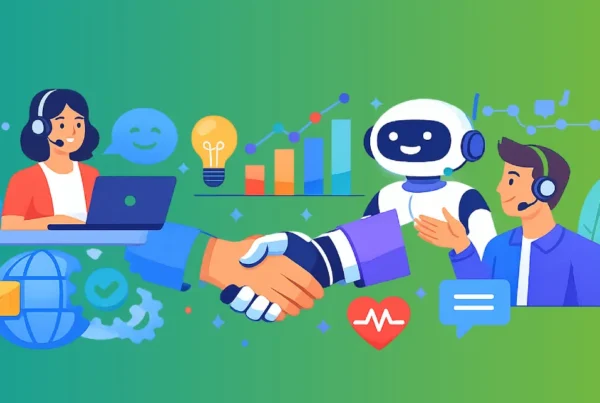
We believe that AI shouldn’t replace humans; it should empower them. Our model combines the efficiency of advanced automation with the empathy and critical thinking of expert human agents. This approach has helped our clients achieve up to 75% cost savings while actually improving customer satisfaction scores.
Meet Angel Tel and Angel X
To solve the technical hurdles mentioned above, we utilize our proprietary tech stack:
- Angel Tel: Our robust infrastructure layer that ensures crystal-clear voice quality and zero-latency connections, solving the common performance issues that plague most contact center AI setups.
- Angel X: The “Experience” layer. This is where our advanced AI lives, handling sentiment analysis, intent mapping, and providing real-time “Agent Assist” to our human teams. It’s designed to bridge the gap between self-service and high-touch support.

Why Choose Vsynergize?
- 20+ Years of Expertise: We’ve been in the trenches of customer experience since before “AI” was a buzzword. We know what works in the real world, not just in a lab.
- Massive Cost Efficiency: Our optimized workflows and “People+AI” model can slash your operational costs by up to 75%.
- Seamless Integration: Whether you need self-service strategies or high-level BPM solutions, we integrate directly into your existing ecosystem.
Stop Troubleshooting and Start Transforming
If your AI contact center is currently a source of stress, it’s time for a paradigm shift. Don’t settle for “good enough” technology that leaves your customers frustrated and your agents burnt out.
The future of customer experience is a seamless blend of human intelligence and artificial efficiency. Are you ready to see what that looks like in action?
Ready to Save Up to 75% on Contact Center Costs?
Let’s explore what an AI-first, empathy-led operation looks like when it’s built the right way—with seamless AI-to-human handoffs, real-time learning, and measurable ROI.
Book a demo, contact Vsynergize, or (even faster) run the numbers yourself.
Use our BPO Cost Estimator to see exactly how much you can save by switching from traditional, human-only support to Vsynergize’s AI-powered solutions:
Stop guessing your savings and start seeing them in real-time.
Calculate Your Savings with the BPO Cost Estimator
- Compare today’s operating costs vs. an AI + human model built for operational efficiency
- Identify your best-fit path to up to 75% cost savings
Book a demo / Contact Vsynergize to start transforming your AI contact center.
FAQ’s
Why do AI contact centers fail?
AI contact centers typically fail for a number of reasons. Sometimes it’s because their business goals are not well defined, or maybe the quality of data they base their operations on is too low. Other times, it could be the lack of proper integration with existing systems that causes the downfall of AI contact centers.
What are the most common problems with AI contact centers?
Some of the common problems are chatbot giving incorrect answers, not really understanding the user, the human-AI collaboration being almost absent, difficulties in the integration of the CRM system, and, not to mention, the limited ability of the chatbot to deal with complex customer problems. All these can cause the customer to get frustrated and lower the service efficiency.
How can you fix an underperforming AI contact center?
At the core of fixing an underperforming AI-powered contact system, a company should focus on enhancing the quality of data, setting clear objectives, regularly training the AI techniques, and mixing automation with human agents for complicated issues. Performance tracking and periodic updating of workflows also support continuing precision and productivity.
Can AI completely replace human agents in contact centers?
Actually, AI is most effective when it’s a support for human agents rather than their replacement. For instance, AI can take over monotonous jobs, deal with straightforward questions, etc. However, even challenging or emotionally charged requests from customers are situations where human considerations and feelings are needed.
How does poor data affect AI contact center performance?
AI systems are highly dependent on data for recognizing customer questions and offering proper answers. When the data is old, scarce, or contradictory, the AI system might give wrong answers, make direct calls to incorrect agents, or result in undesirable customer experiences.
What role does human-AI collaboration play in contact centers?
Human-AI partnership leads to customer experience uplift. In fact, while AI-driven tools can efficiently execute routine tasks and even process a gigantic amount of conversations, human customer service representatives are the ones who can and have to step in for highly complex and emotional issues where compassion, reasoning, and empathetic support are required.
How can businesses improve AI adoption in contact centers?
Companies can leverage artificial intelligence to enhance employee engagement issues through training; slowly rolling out the new AI software in conjunction with old tools, e.g, a CRM system, defining goals clearly, and regularly tracking AI results. Besides that, warmly welcoming the agents and having sincere conversations with them may turn out to be a very effective method to gain their trust and achieve a higher adoption rate.