
In the year 2026, insurance will be characterized by accuracy. Customers expect to be able to easily understand. Regulators expect that there will be a consistent method. Leadership expects operational reliability. Meeting all three at the same time has become a requirement, no longer an aspiration. This change explains the increased attention by insurers towards the Top 20 global BPO companies, as part of their broader strategy to modernize insurance operations and policy servicing BPO services/insurance outsourcing solutions. These companies have transitioned from being outside vendors to being an embedded partner in the insurance value chain, providing an influence on rapidity, correctness,s and policyholder trust. Studies show that 76% of insurance customers expect consistent interactions across departments, and 90% of customers expect immediate responses to service questions, underlining the rising expectation for clarity and speed in 2026.
Let’s think about an average experience. An insurance policyholder submits a claim online and, within minutes, receives a confirmation back via electronic format as opposed to multiple days later through the postal service. Sitting underneath this very simple transaction are many different and complex steps that take place including receiving and entering documents into a system, acknowledging the submission was received, validating that the documentation provided is accurate, completing necessary compliance checks, and communicating with the policyholder. If everything is working in the background, typically, there is no concern from anyone. However, if something is not working properly or there is a breakdown at any point in the process, the insurance company suffers silently as its brand equity erodes.
This reality has shifted, where insurance BPO organizations are now located strategically within the overall business strategy for any insurance company.
The New Expectations Shaping Insurance Operations
Nowadays, the way that people purchase insurance is not the same as before. Consumers of insurance will often evaluate the responsiveness they received from financial apps, e-commerce platforms, or similar financial transactions in the past when comparing their experience with buying insurance.
Gartner states that when insurers leverage specialized partners to modernize their operations, they will achieve greater consistency in turnaround times across multiple customer touchpoints.
This aligns with findings from Deloitte, which reports that insurers using hybrid operating models, combining internal leadership with specialized BPO partners, achieve higher service consistency and faster response times across digital and assisted channels.
Increasingly, internal departments are under pressure from numerous areas; new products must be developed, regulatory compliance must be achieved, the ability to protect their data and the company from cybersecurity attacks must be maintained, and digital transformation continues to require significant resources. Outsourcing non-core operational workflows will allow leadership teams to dedicate their time to those areas that provide the highest level of strategic advantage.
This is how the Top 20 insurance BPO companies by 2026 will set themselves apart from all other insurance companies.
From Cost Reduction to Operational Confidence
Historically, the insurance BPO market was largely driven by cost reduction and labour arbitrage through the use of different geographies. This is no longer a leading principle.
Leading providers can now deliver:
- Process accuracy across many locations
- Consistent service levels
- Aligned data governance to U.S. regulations
- Technology-enabled workflows
- Transparent reporting structures
According to McKinsey & Co., the partnership with advanced BPO’s has allowed insurers to enhance operational resilience without adding internal complexity.
Why 2026 Is a Turning Point for Insurance BPO
The following forces converge in the year 2026:
-
Automation is at Maturity
Workflow execution and AI-based document processing are fully mature.
-
Heightened Oversight from Regulatory Requirements
Data management, audit trails, and compliance review/reporting expectations have increased significantly.
-
Reduced Availability of Customer Patience
There will be no patience among customers for delays in services (even if there is a logical reason for a delay).
-
Optimal Use of a Workforce
Insurers are attempting to deliver scalable talent resources while not increasing fixed costs.
-
Cross-Industry Convergence
Proven delivery models from BPO for Banking & Financial Services are increasingly being applied to insurance, bringing mature governance, risk controls, and transaction accuracy into insurance operations.
Deloitte finds that insurers using hybrid operating models (bots that combine both specialized business process outsourcing with in-house leadership) have a higher level of consistency in service delivery.
Additional analysis from PwC shows that insurers aligning outsourcing strategies with digital transformation initiatives experience improved audit readiness and stronger policyholder retention.
Because of these changes, it will become increasingly more important to select the right 20 BPO companies to service insurance companies in 2026 as opposed to choosing from a pool of general outsourcers.
A Practical Note for Decision-Makers
Those evaluating today’s BPO providers are evaluating several priorities at the same time. The priority items being evaluated include speed of service, security of service, and the overall customer experience. A suitable business process outsourcing partner will simplify the priorities in place with the provider rather than compound the number of policy-processing complications and provider limits. This is where Business Process Consulting and Business Process Optimization play a critical role, helping insurers redesign workflows, remove inefficiencies, and align operations with measurable business outcomes before scale is introduced.
This article is not meant to confuse, but rather provide clarity about how leading BPO providers operate, what impact they have on differentiated products and services, and how insurance companies can effectively use them as part of their insurance operations strategy.
To achieve this overall clarity, you first need an understanding of the ecosystem.
How Insurance BPO Has Evolved Into a Growth Enabler
The Insurance BPO landscape is evolving. Today, rather than primarily providing backend operational support as was the case in prior years, Insurance BPO plays an important role in the growth of an organization, establishing customer trust, and providing operational stability. Insurers now have a much greater expectation of BPO partners providing intelligence as opposed to simply executing work.
Previously, outsourcing was primarily based on task completion. In contrast, today’s Insurance BPO focuses on the outcome. This change is the key reason why organizations are focusing on how to shortlist the Top 20 Insurance BPO companies in 2026 based on value creation, rather than volume of processing.
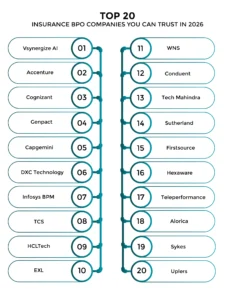
Top 20 Insurance BPO Companies in 2026
The following list ranks the top 20 insurance BPO companies for 2026 using criteria such as coverage of the insurance domain, maturity of technology, readiness for compliance, and impact on the customer experience (CX).
-
Vsynergize AI
Workforce Size: Approximately 300–500 professionals
Year of Inception: 2020
Total Employees: Privately held; estimated within the same range
Location: United States and India
Vsynergize AI has been recognized as one of the best BPO providers for the insurance industry as of 2026. The company’s approach is to deliver an AI-first and compliance-driven business operations model, which was created specifically for the insurance industry. This approach is further strengthened by a structured Business Process Management (BPM) framework that standardizes workflows, improves process visibility, and ensures consistent outcomes across insurance operations.
Vsynergize AI’s strengths include:
- AI tools that enable claims and policy workflow management
- Ability to securely and auditable process data
- Ability to provide an automated customer experience while maintaining the ability for human oversight
- Ability to scale the services we provide to our customers in the U.S.
Vsynergize AI focuses on results and delivers measurable results in addition to providing a service, making the company a great partner for insurance providers who want speed without risk.
-
Accenture
Workforce Size: Over 700,000 professionals
Year of Inception: 1989
Total Employees: Public company; global workforce exceeds 700,000
Location: United States with global delivery centers
Accenture will continue to be a leader in 2026 among the top 20 companies that offer BPO services in the insurance industry by leveraging its ability to combine consulting, technology, and operations at scale. Accenture collaborates with insurers on many elements of their operations: claims processing, underwriting assistance, policy administration, and customer experience management. Accenture’s value proposition is that it can help the insurer place automation and analytics into its workflow while ensuring compliance and governance measures are being followed. Accenture’s global delivery model allows an insurer to have consistent standards across its various geographic locations while complying with local laws, thus providing the insurer with credibility to act as a trusted partner within the very complicated insurance industry ecosystem.
-
Cognizant
Workforce Size: Approximately 340,000 professionals
Year of Inception: 1994
Total Employees: Public company; workforce reported globally
Location: United States and India
As one of the top 20 BPO companies in the insurance industry in 2026, Cognizant is an excellent provider of BPO services for the insurance industry, with a strong digital platform that enables insurers to meet their business needs. The company delivers value through claims management, policy servicing, underwriting support, and customer engagement. Cognizant emphasizes the use of data and operational transparency to help insurers make decisions based on data and provide a consistent experience across multiple interactions with customers. Cognizant provides BPO service solutions for the insurance sector, which integrate effortlessly into an insurer’s primary insurance systems. By doing this, insurers can improve the speed of service and save significant time on returns. In addition, with these solutions from Cognizant, insurers can have greater assurance that their high-volume processing will be accurate and compliant.
-
Genpact
Workforce Size: Approximately 115,000 professionals
Year of Inception: 1997
Total Employees: Public company; global employee base
Location: United States, India, and global markets
For the year 2026, Genpact made its presence known in the top twenty insurance BPO companies based on their excellent process and data analytics-led services being provided through structured operational frameworks as related to claims processing, underwriting aassistancece and policy administration. Genpact employs a continual improvement model based on the use of automated and intelligent process workflows to drive operational results. Insurers appreciate Genpact as an organisation capable of delivering consistent service levels, reliable reporting, and full operational transparency when aligned to regulations and audit requirements within well-developed insurance markets.
-
Capgemini
Workforce Size: Over 350,000 professionals
Year of Inception: 1967
Total Employees: Public company; global workforce
Location: France, the United States, and worldwide operations
Due to their extensive knowledge of the insurance domain and utilising their compliance-first delivery system, Capgemini is one of the top twenty (20) insurance BPO companies in 2026. They provide end-to-end BPO service to insurers through claims processing, policy administration,n and consumer service, and do so while integrating digital technologies and process automation with strong data governance models in place. The balance achieved by Capgemini between technology, process control, and compliance/regulatory practices makes it an excellent outsourcing partner for insurers seeking operational stability.
-
DXC Technology
Workforce Size: Approximately 130,000 professionals
Year of Inception: 2017
Total Employees: Public company; global workforce
Location: United States and international delivery centers
With many years of cooperation as a partner with insurers supplying outsourcing service solutions, DXC Technology is on track to continue to be one of the 20 largest providers of global insurance BPO’s by the year 2026. DXC has the ability to provide large-scale solutions that support all types of BPO functions associated with insurance (e.g., claims processing, policy administration, etc.).
Even though DXC has been delivering BPO services for over twenty years, it is particularly strong in supporting its clients’ large, complex, and highly legacy-based insurance environments while allowing its clients to modernise those environments on a gradual basis. Insurers worldwide have relied upon DXC since 1994 for consistent service delivery, structured governance, and the ability to support mission-critical operations in multiple global markets.
-
Infosys BPM
Workforce Size: Approximately 55,000 professionals
Year of Inception: 2002
Total Employees: Subsidiary of Infosys Limited
Location: India, the United States, and global delivery centers
Following in DXC’s footsteps, Infosys BPM has emerged as one of the top 20 global insurance BPOs due to its automated-first approach to providing services to insurers. Specifically, Infosys BPM’s insurance BPO services are focused primarily on claims processing, underwriting support, and policy servicing, and have significant integration with the insurer’s digital platforms. In the delivery of these services, Infosys BPM places a strong emphasis on operational efficiency, accuracy, and scalability of data to ensure that its clients have the ability to manage volume fluctuations while maintaining a consistent quality of service.
-
TCS
Workforce Size: Over 600,000 professionals
Year of Inception: 1968
Total Employees: Public company; global workforce
Location: India with worldwide operations
TCS is one of the top 20 BPO players in the insurance industry in 2026; it provides an array of tightly linked technology and BPO services to help clients manage their end-to-end policy lifecycle from underwriting assistance to claims service delivery. In addition to that, TCS focuses on developing standardised processes, automating operations,s and utilising analytics-based information to improve operations. TCS assists insurers in achieving uniformity, scalability, and operational efficiency across their company lines through the alignment of BPO processes with their client’s insurance platforms.
-
HCLTech
Workforce Size: Approximately 225,000 professionals
Year of Inception: 1976
Total Employees: Public company; global employee base
Location: India, the United States, and international markets
HCLTech is another one of the top 20 players in insurance BPO services for 2026. The company is focused on delivering digital-driven insurance BPO services that support process optimisation in the areas of claims, underwriting support, and customer operations. The company’s focus on workflow automation, governance, and data integrity will ensure that it continues to attract clients that are looking to modernise their insurance operations while meeting all of the compliance requirements needed to operate in heavily regulated environments. HCLTech is also focused on developing structured transition models to ensure that clients maintain their service levels throughout the process of modernising their insurance operations.
-
EXL
Workforce Size: Approximately 55,000 professionals
Year of Inception: 1999
Total Employees: Public company; global operations
Location: United States, India, and global delivery centers
EXL is considered one of the Top 20 insurance BPOs in 2026 due to its analytics-oriented insurance outsourcing strategy. The company delivers domain expertise, together with advanced data analytics, to support insurers in claims processing, underwriting decisions, and policy servicing. Insurers can enhance the quality and accuracy of their decisions as it pertains to claims, underwriting, and policy servicing through the use of EXL’s focus on insight-based business operations.
Through the use of EXL’s focus on insight-based business operation, insurers can improve the quality and accuracy of the decision-making process regarding claims, underwriting, and policy servicing.
-
WNS
Workforce Size: Approximately 60,000 professionals
Year of Inception: 1996
Total Employees: Public company; global workforce
Location: United States, India, and international markets
WNS is also rated one of the top 20 insurance BPOs in 2026 due to its strong delivery record and deep specialized insurance knowledge. WNS wins clients because of its easy-to-use approach to claims administration, underwriting, and customer interactions with the client.WNS’s emphasis on domain-delivered service with standardized process methodologies, quality assurance measurements, nd compliance provides insurers with a dependable partner that will produce scalable operations, strong governance, and predictable service outcomes over a wide variety of insurance portfolios.
-
Conduent
Workforce Size: Approximately 65,000 professionals
Year of Inception: 2017
Total Employees: Public company; global employee base
Location: United States and global delivery locations
Conduent received recognition as one of the Top 20 Insurance BPOs due to the company’s ability to manage complex insurance workflows and significant customer interactions. Conduent also provides insurance claims processing and policy administration services along with digital communication, as part of their Business Process Outsourcing (BPO) functions. Additionally, Conduent provides specific tools and processes to help insurers optimize workflows and provide accurate and compliant regulatory support, thus giving insurers the ability to provide higher-quality services for their customers, control access to their data, and maintain operational governance.
-
Tech Mahindra
Workforce Size: Approximately 150,000 professionals
Year of Inception: 1986
Total Employees: Public company; worldwide workforce
Location: India, the United States, and international markets
Tech Mahindra further strengthens the list of Top 20 Insurance BPOs in 2026 with an extreme focus on experience-led Outsourcing for Insurance. Through an integrated approach between operational efficiency & customer engagement, Tech Mahindra provides BPO services for insurance Companies which combine digital platforms, automation & analytics within the insurance workflow. As a result, Insurers utilize Tech Mahindra’s capabilities to improve customer interaction while achieving back office accuracy & compliance, providing consistent service delivery across multiple channels.
-
Sutherland
Workforce Size: Approximately 40,000 professionals
Year of Inception: 1986
Total Employees: Privately held; global workforce
Location: United States, India, and international delivery centers
In 2026, Sutherland was recognized as one of the Top 20 insurance BPO companies due to their customer-driven methods of providing outsourcing solutions for insurance providers. The company Sutherland helps insurance companies and clients with claim support, policy servicing, and other forms of customer service. They focus on the CX (Customer Experience) Framework, operational discipline, and the way technology is integrated into their processes.
-
Firstsource
Workforce Size: Approximately 30,000 professionals
Year of Inception: 2001
Total Employees: Public company; global operations
Location: India, the United States, and international markets
Firstsource maintains a significant place within the Top 20 Insurance BPO Companies category since it is focused on providing outcome-based insurance services. Firstsource’s insurance-related services include: claims processing, support for underwriting, and customer service support with a focus on operational effectiveness. In addition, Firstsource utilizes analytics and process improvement methodologies to help ensure efficient and effective service delivery. Overall, Insurance Companies like to work with Firstsource’s structured delivery model and their emphasis on measurable service delivery.
-
Hexaware
Workforce Size: Approximately 30,000 professionals
Year of Inception: 1990
Total Employees: Privately held; global employee base
Location: India, the United States, and global delivery centers
Hexaware is part of the Top 20 Insurance Bpo Companies in 2026 through its Automation-Centric Insurance Outsourcing Strategy. It uses Intelligent Workflows to Help Support the Processing of claims, policy administration, and Data Processing. By allowing insurers to use automation to streamline their operations while still providing them with good governance, compliance, and access to controls and visibility, Hexaware’s focus is on reducing the amount of manual effort required by delivering a delivery method that allows for a high level of control and visibility through the use of automation.
-
Teleperformance
Workforce Size: Over 410,000 professionals
Year of Inception: 1978
Total Employees: Public company; global workforce
Location: France, the United States, and worldwide operations
Teleperformance is included in the Top 20 Insurance Bpo Companies in 2026, As The Company is a Global Leader in Providing Customer Experience. The Company Provides Insurers with a Variety of Services Related to Customer Service, Claims Assistance, and policyholder engagement. Teleperformance Uses A Combination of Multilingual Delivery Applications and Standardized Processes to Deliver Its Services To Clients. Teleperformance Is Highly Respected By Insurers For Its Ability to Effectively Service Large Numbers of Customer Interactions With The Consistency of Service and compliance with regulatory specifications.
-
Alorica
Workforce Size: Approximately 100,000 professionals
Year of Inception: 1999
Total Employees: Privately held; global workforce
Location: United States and international delivery centers
Alorica is Listed in The Top 20 Insurance Bpo Companies In 2026, Based on Its Customer-Centric Insurance Outsourcing Services. Alorica Delivers Customer Engagement Services Including Policy Servicing, Claims Support, and Customer Engagement. Alorica provides CX that is delivered in a structured way to allow for consistency in process and to ensure reliability for customers. Quality and Scalability provide Insurers the opportunity to deliver high-quality customer operations.
-
Sykes
Workforce Size: Approximately 55,000 professionals
Year of Inception: 1977
Total Employees: Public company; global operations
Location: United States and international markets
Sykes is still considered one of the premier 20 insurance bpo companies in 2026 due to giving focused customer operations and support services to the insurance industry. With Sykes, insurers have assistance with all customer communications, inquiries about policies, and interaction with their claims. The Sykes team believes in service consistency,y along with agent training and process adherence,,ce to deliver both consistent quality of outcome and also deliver consistent messaging to maintain trust between the insurer and its customers through all of the high-touch interactions they have with their insurance provider.
-
Uplers
Workforce Size: Approximately 1,000–1,500 professionals
Year of Inception: 2012
Total Employees: Privately held; estimated within the same range
Location: India and the United States
Completing the top 20 insurance bpo companies’ list for 2026 is Uplers, which is a flexible, digital-first provider of outsourced support services for insurance organizations. Uplers provides insurance organizations with skilled resources for digital operations, analytics support, and process execution. Uplers focuses on agility, scalability, and speed of deployment. Uplers model is an ideal fit for insurance companies that want to augment their internal teams while maintaining control of their workflows and service quality.
How to Select the Right Partner From the Top 20 Insurance BPO Companies in 2026
When selecting among the best insurance BPO companies in the Insurance sector for 2026, it should not be a focus on size, but on how well aligned they are with your company. Insurance firms that commit to outsourcing make sound, strategic decisions via a structured process for evaluation rather than just using a list of features of potential vendors to judge them by.
This section will assist you with this.
-
Start with Business Outcomes, Not Services
High-performing insurance firms will have defined their success before reviewing vendors. They will have asked themselves direct questions such as:
- Do we want to resolve claims faster than we currently do?
- Do we want to enhance our communication with our policyholders?
- Do we want the scalability of our operations without having fixed overhead?
The most successful insurance companies will connect their business outcomes to the top 20 bpo vendors from 2026 that have proven capabilities to deliver on these business outcomes.
According to Gartner, there are higher levels of satisfaction and long term success associated with outcome-based outsourcing than there are with scope of work-based contracting.
-
Evaluate Insurance-Specific Depth
Because Insurance Workflows are regulated data, not all BPO experiences will transfer into the insurance industry. In addition, due to the sensitive nature of their customers’ needs, insurance providers have a requirement for a structured method of decision-making.
When looking for the Top 20 Insurance BPO vendors in 2026, look for:
- Business Units for Specific Types of Insurance
- Adept in Lines of Insurance (e.g., property/casualty, life/health)
- Experience in Claims and Underwriting
- Experience with US Insurance Laws
- Native Delivery Models for Insurance (having significantly less onboarding and governance barriers).
-
Assess Technology Enablement, Not Just Tools
Maturity is not determined by automation alone. What counts is the degree to which technology is integrated into a company’s workflow.
The leading companies in the top 20 of insurance bpos in 2026 use technology for:
Increasing processing accuracy
Reducing manual touch points
Creating an audit-ready report
Facilitating real-time visibility
According to McKinsey research, the highest Return on Investment from Automation occurs when it is part of a process rather than being added after the fact.
-
Prioritize Governance and Transparency
Governance in a company allows officials to reassure customers that they will have a reliable service regardless of the reasons for the delays:
- Much larger number of items received than anticipated (although your current Vendor may experience an increase in volume above what is anticipated).
- Great large changes in Rules globally (HIPG – HIPAA – etc.).
When comparing your BPO to the top 20 insurance BPO companies you deal with now during time periods (10-12 years, 2006), it is essential to look at:
- How frequently you receive reports,
- How will you escalate issues to your current vendors?
- How can you easily pass Department of Insurance audits on the Vendor you are using now?
- If your vendors provide you with access controls/identity management/role-based access for compliance with proper government requirements.
The ability of your current Vendor to provide Governance to you as well.
How Vsynergize AI Approaches Insurance BPO in 2026
In the year 2026, insurance BPO will demand precision, transparency, and operational intelligence. Vsynergize AI uses an outcome-driven design for its approach to delivering outsourced Insurance services instead of a volume-based execution methodology. The Vsynergize AI model utilizes the embedding of AI-enabled workflows within primary insurance processes while allowing for human supervision at critical decision lanes within those processes. Governance, data security, and regulatory compliance are fundamental to every engagement. The Vsynergize AI design of scalable insurance operations leads to predictable scaling and are audit ready, leading to an improved customer experience through increased speed, accuracy, and improved quality without adding additional operational complexity or risk.
Are You Prepared To Enhance Your Insurance Business Processes?
Selecting an appropriate BPO service provider within the Top 20 BPO Companies (at least 15 years of experience) in 2026 can be easy if you have clear objectives/understanding of your needs before starting this process. It doesn’t matter if your goal is to modernize your business processes, improve customer experience, or scale quickly; the right partner can help you achieve all three of these objectives.
Get in touch with our Insurance Outsourcing Experts today.
Learn how an AI-driven BPO solution can help you achieve these goals with greater confidence and control.
Conclusion: Making the Right Choice in 2026
Partnerships focused on outcomes and their overall effectiveness over a long period (2026), due to how the technology will be used in integrating various elements together, rather than just providing short-term efficiencies, will help to create and sustain long-term partnerships that deliver superior results by focusing on achieving goals/quantities. The right choice will help build service quality, customer trust, and focus on core competencies tomorrow.
The leading providers of business process outsourcing (BPO) for insurance companies in 2026 represent a well-established ecosystem of service providers that can support their clients through complex operational challenges. Each provider brings to the table unique strengths and weaknesses, but they all have common characteristics of good governance, experience in the insurance industry, and operate using technology to enable their operations.
FAQs
1. What services do insurance BPO companies typically provide?
Insurance BPO companies assist with claims processing, underwriting assistance, policy administration, customer service, compliance reporting, and analytics-driven operations.
2. Are insurance BPO services suitable for U.S.-based insurers?
Yes, providers that are industry leaders follow a two-step approach to aligning their delivery models with U.S. regulations, rules for protecting data, and audit frameworks.
3. How does AI support insurance BPO operations?
AI enhances processing accuracy and speed, increases document processing speed, while adding new capabilities for workflow visibility, improving the overall process of maintaining human oversight of decision-making.
4. How should insurers evaluate insurance BPO partners?
In determining whether to partner with or acquire an insurtech company, insurers should consider five key factors: insurance knowledge, governance structure, technology integration, scalability, and cultural compatibility.
5. Can mid-sized insurers benefit from insurance BPO services?
Yes, there are several providers who provide multi-layer and scalable models of engagement in insurance institutions, medium and large in size.