
- Introduction
- Understanding the True Cost of an In-House Team
- What Does Back Office Outsourcing Include?
- Cost Comparison: In-House vs Back Office Outsourcing
- When Does an In-House Team Make More Sense?
- When Is Back Office Outsourcing the Better Choice?
- How AI Is Making Back Office Outsourcing Even More Cost-Effective
- How to Choose the Right Back Office Service Provider
- Ready to Streamline Your Back Office Operations with Vsynergize?
- Conclusion
Key Takeaways
- In-house teams offer greater direct control, but their true cost goes beyond salaries to include hiring, benefits, training, software, infrastructure, and ongoing management.
- Back office outsourcing can reduce overhead by giving businesses access to trained teams without the cost of building and maintaining a full internal operation.
- Outsourcing can cover a wide range of functions, including data entry, document processing, finance and accounting, order processing, customer support, research, and administrative tasks.
- In-house teams may be the better fit when processes require highly specialized knowledge, close internal collaboration, or frequent hands-on oversight.
- Outsourcing often makes more sense for repetitive, high-volume, or easily standardized processes, especially when workload changes with seasons or business growth.
- AI and automation are making outsourced operations more efficient by reducing manual work, improving data processing, accelerating workflows, and allowing teams to focus on tasks that require human judgment.
- The right provider matters as much as the outsourcing model. Look for relevant industry experience, strong security practices, measurable SLAs, quality controls, scalability, transparent pricing, and effective technology.
- The best choice is not always about choosing one model over the other. A hybrid approach can keep strategic or sensitive functions in-house while outsourcing routine processes to improve efficiency and control costs.
- The goal is sustainable operational efficiency, not simply finding the lowest-cost option. The right model should improve productivity, quality, scalability, and overall business performance.
Every growing business reaches a point where back office work starts demanding more time, resources, and attention than expected. Tasks like data entry, finance support, customer documentation, payroll, reporting, and administrative processes may not directly generate revenue, but they keep the business running. The question is whether these operations should be managed by an internal team or outsourced to a specialized service provider.
At first glance, hiring an in-house team often feels like the safer option. You have employees working under your roof, complete visibility into daily operations, and direct control over processes. But the actual cost goes far beyond monthly salaries. Recruitment, onboarding, employee benefits, office infrastructure, software licenses, training, and ongoing management all contribute to the total investment.
Back office outsourcing offers a different approach. Instead of building an internal department from the ground up, businesses gain access to experienced professionals, established workflows, and scalable support without carrying the long-term overhead of a growing workforce.
The right choice depends on your business goals, growth plans, and operational needs. In this guide, we’ll compare both models, break down the real costs involved, and help you determine which option delivers better value for your organization.
Book an AI BPO Consultation
Looking to reduce costs, improve customer experience, and scale operations intelligently? Discover how AI-powered BPO solutions can streamline your customer support and back-office processes.
Understanding the True Cost of an In-House Team
Many companies calculate hiring costs by looking at salaries alone. In reality, salary is only one part of the equation. Building and maintaining an in-house back office team involves several ongoing expenses that often become more noticeable as the business grows.
Recruitment and Hiring Costs
Finding qualified employees takes both time and money. Job advertisements, recruitment agencies, HR resources, background verification, interviews, and onboarding all require investment before a new employee even begins contributing.
If turnover is high, these costs repeat throughout the year.
Employee Benefits and Compliance
An in-house workforce comes with mandatory and competitive benefits such as:
- Health insurance
- Paid leave
- Retirement contributions
- Performance bonuses
- Payroll taxes
- Compliance with labor regulations
These expenses increase the overall cost of employment significantly beyond the advertised salary.
Infrastructure and Technology
Every employee needs the right tools to work efficiently. Businesses must invest in:
- Office space
- Computers and hardware
- Business software
- Communication tools
- Security systems
- IT support
- Data storage and backup
As teams expand, infrastructure costs grow alongside them.
Training and Skill Development
Business processes constantly evolve. New technologies, compliance requirements, and workflow improvements require regular employee training.
Organizations often spend considerable time helping new hires reach full productivity while also investing in continuous learning programs for existing staff.
Management and Productivity Costs
An internal team also requires supervision. Managers spend time on:
- Performance reviews
- Work allocation
- Quality control
- Process improvements
- Team meetings
- Employee engagement
These management responsibilities carry their own operational cost that is rarely included in hiring calculations.
The Hidden Cost of Limited Scalability
Business demand rarely stays constant. During busy seasons, internal teams may become overloaded, causing delays and lower productivity. During slower periods, companies continue paying full salaries even when workloads decrease.
This lack of flexibility makes in-house operations less cost-efficient for many growing businesses.
What Does Back Office Outsourcing Include?
Back office outsourcing involves delegating non-customer-facing business functions to an experienced external team. Rather than hiring employees for every administrative process, businesses partner with specialists who already have trained professionals, proven workflows, and supporting technology in place.
The exact services vary by industry, but most back office outsourcing providers support a wide range of operational functions.
Data Entry and Data Management
Accurate business data is essential for informed decision-making. Outsourcing providers handle:
- Data entry
- Data cleansing
- Database management
- Record digitization
- Document indexing
- Data validation
This improves accuracy while reducing manual workload for internal teams.
Finance and Accounting Support
Many businesses outsource repetitive financial processes such as:
- Accounts payable
- Accounts receivable
- Invoice processing
- Expense management
- Financial reporting support
- Payroll administration
This helps finance teams focus on planning and business strategy rather than routine administrative work.
HR and Employee Administration
Outsourced HR support often includes:
- Employee onboarding documentation
- Payroll processing
- Benefits administration
- Leave management
- HR record maintenance
- Recruitment support
These services reduce administrative pressure on internal HR departments.
Document Processing and Compliance
Organizations dealing with high volumes of paperwork often outsource:
- Document verification
- Claims processing
- Contract management
- Compliance documentation
- Regulatory reporting support
Experienced providers maintain standardized workflows that improve consistency and reduce processing errors.
Customer Support Administration
While customer service is often customer-facing, many supporting processes happen behind the scenes, including:
- CRM updates
- Ticket management
- Order processing
- Customer documentation
- Email categorization
- Case management support
These functions help customer-facing teams respond faster and more accurately.
Industry-Specific Back Office Services
Many outsourcing providers also offer specialized support tailored to industries such as healthcare, banking, retail, insurance, telecommunications, logistics, and eCommerce. These services are designed around industry regulations, operational workflows, and compliance requirements, allowing businesses to maintain efficiency while meeting sector-specific standards.
Cost Comparison: In-House vs Back Office Outsourcing
When businesses compare costs, the discussion often begins with salaries. However, the more meaningful comparison looks at the total cost of ownership over time.
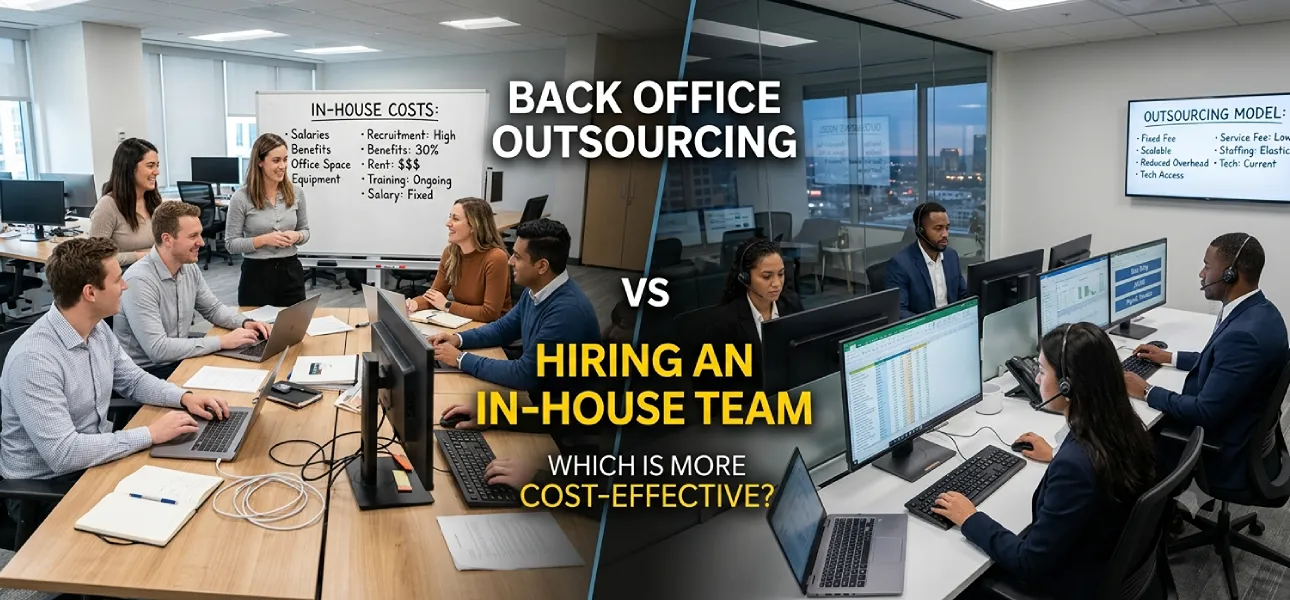
An in-house team requires continuous investment across hiring, infrastructure, employee benefits, technology, management, and training. These expenses remain largely fixed regardless of business demand.
Back office outsourcing follows a different model. Instead of building internal capabilities, businesses pay for operational expertise and service delivery. Most outsourcing providers already have trained professionals, established processes, technology platforms, and quality management systems in place. This allows companies to avoid many upfront and ongoing operational expenses.
The financial difference becomes even more noticeable as businesses grow. Expanding an internal team often means recruiting additional employees, purchasing more equipment, increasing office space, and extending management capacity. Outsourcing providers, on the other hand, can typically scale support much faster without requiring the business to make significant capital investments.
Beyond direct cost savings, outsourcing also reduces indirect costs associated with employee turnover, recruitment delays, productivity gaps during onboarding, and maintaining specialized expertise across multiple back office functions.
Cost Factor | In-House Team | Back Office Outsourcing |
Recruitment | High | Included in service |
Employee Benefits | High | Managed by provider |
Office Infrastructure | Required | Not required |
Software & Technology | Business investment | Usually included |
Training | Ongoing expense | Provider responsibility |
Scalability | Slow and costly | Flexible and fast |
Process Expertise | Built internally | Available immediately |
Operational Risk | Managed internally | Shared with provider |
While every organization has different requirements, many businesses find that outsourcing delivers greater cost efficiency, especially when managing repetitive, process-driven back office operations at scale.
When Does an In-House Team Make More Sense?
Although outsourcing offers significant advantages, it isn’t the right solution for every situation. Certain business functions benefit from remaining entirely within the organization, particularly when close collaboration, strategic decision-making, or highly sensitive information is involved.
When Processes Require Daily Cross-Team Collaboration
Some back office activities are deeply integrated with multiple departments and require continuous communication with leadership, operations, finance, or product teams.
When quick decisions, real-time discussions, and constant alignment are essential, an internal team may provide greater operational efficiency.
When Handling Highly Confidential Business Information
Organizations managing highly sensitive intellectual property, proprietary research, or confidential strategic planning may prefer to keep certain operations in-house.
While reputable outsourcing providers maintain strong security standards, some companies choose internal control for functions involving critical business assets.
When Workflows Are Highly Customized
Businesses with unique internal systems, specialized approval structures, or complex operational processes may find that an in-house team adapts more easily to frequent workflow changes than standardized outsourced operations.
When Internal Expertise Creates Competitive Advantage
If a back office function directly supports innovation, product development, or strategic differentiation, investing in an internal team can strengthen long-term business capabilities and preserve valuable organizational knowledge.
When Workforce Stability Is a Long-Term Priority
Organizations with predictable workloads, stable growth, and sufficient operational budgets may benefit from developing an experienced in-house team over time. Long-serving employees often build deep institutional knowledge that supports consistency and continuous process improvement.
When Is Back Office Outsourcing the Better Choice?
Back office outsourcing is not just about reducing payroll costs. For many businesses, it is a practical way to improve efficiency, access specialized expertise, and keep internal teams focused on work that drives growth.
Here are some situations where outsourcing delivers the greatest value.
When Your Business Is Growing Quickly
Growth often creates operational challenges. More customers mean more invoices, more data to process, more compliance requirements, and more administrative work.
Hiring and training an internal team takes time. A back office outsourcing partner allows you to expand operations without slowing down your business. You can increase support during busy periods and scale back when demand changes, without the costs of constant recruitment.
When You Need to Control Operating Costs
Building an in-house back office comes with ongoing expenses that continue long after hiring. Salaries, employee benefits, office infrastructure, software licenses, training, and management all add to your operational budget.
Outsourcing converts many of these fixed costs into predictable service fees. This makes budgeting easier while reducing overhead without compromising service quality.
When Administrative Work Is Slowing Your Core Team
Your sales, customer support, and leadership teams deliver the greatest value when they focus on customers and business strategy—not repetitive administrative tasks.
Functions such as data entry, document processing, invoice management, reporting, and record maintenance can consume valuable working hours. Outsourcing these responsibilities allows internal teams to concentrate on higher-value work while experienced specialists handle routine operations.
When You Need Specialized Skills Without Building a Large Team
Many back office functions require expertise in areas such as finance, healthcare administration, compliance, claims processing, or data management.
Hiring specialists for every function may not be practical, especially for growing businesses. An outsourcing partner provides access to trained professionals, standardized workflows, and industry best practices without the long-term commitment of expanding your workforce.
When Business Demand Fluctuates
Many industries experience seasonal spikes, product launches, or unexpected increases in workload. Retail businesses prepare for holiday shopping seasons. Healthcare organizations manage changing patient volumes. Financial institutions often experience reporting deadlines.
Back office outsourcing offers the flexibility to increase or decrease support as business needs change, helping organizations avoid both overstaffing and operational bottlenecks.
How AI Is Making Back Office Outsourcing Even More Cost-Effective
Artificial intelligence is changing how modern back office operations are managed. Instead of replacing human teams, AI automates repetitive tasks, improves accuracy, and allows specialists to focus on work that requires judgment and problem-solving.
The result is faster operations, lower costs, and better business outcomes.
Faster Processing With Intelligent Automation
AI can automatically capture information from invoices, forms, contracts, emails, and other business documents. Instead of manually entering data, intelligent automation extracts information, validates it, and routes it to the appropriate systems.
This significantly reduces processing time while allowing teams to handle larger workloads without increasing headcount.
Improved Accuracy and Fewer Manual Errors
Manual data entry is vulnerable to typing mistakes, duplicate records, and inconsistent information.
AI-powered validation tools identify missing fields, detect unusual patterns, and flag potential errors before they affect business operations. This improves data quality while reducing the time spent correcting mistakes.
Lower Operational Costs Over Time
By automating repetitive administrative tasks, businesses reduce the amount of manual effort required for everyday operations. Employees spend less time on routine work and more time on activities that create business value.
This combination of automation and skilled human oversight helps organizations achieve greater efficiency without sacrificing quality.
Better Insights for Smarter Decisions
Modern AI tools do more than automate tasks. They analyze operational data, identify trends, generate performance reports, and highlight areas where processes can be improved.
Instead of reacting to problems after they occur, businesses gain visibility into operational performance and make faster, data-driven decisions.
Scalable Support for Growing Businesses
As transaction volumes increase, AI-enabled outsourcing solutions can process significantly more work without requiring proportional increases in staffing.
Whether a company is entering new markets, expanding customer operations, or managing seasonal demand, AI helps outsourcing teams maintain speed, consistency, and service quality at scale.
How to Choose the Right Back Office Service Provider
Selecting the right outsourcing partner has a direct impact on cost savings, operational efficiency, and long-term business performance. The lowest price is not always the best value. The right provider should strengthen your operations while supporting future growth.
Look for Relevant Industry Experience
Every industry has different processes, compliance requirements, and operational challenges.
Choose a provider with proven experience supporting businesses similar to yours. Industry knowledge reduces onboarding time and helps maintain quality from day one.
Evaluate Technology and Automation Capabilities
Modern back office support should combine skilled professionals with advanced technology.
Ask potential providers how they use AI, workflow automation, quality monitoring, analytics, and secure collaboration tools. Technology-enabled operations typically deliver greater efficiency and faster turnaround times.
Prioritize Data Security and Compliance
Back office processes often involve sensitive customer, financial, or operational data.
Ensure the provider follows strong security standards, implements access controls, encrypts sensitive information, and complies with relevant industry regulations. Protecting business data should be a core part of their operating model.
Assess Scalability and Flexibility
Business needs change over time. Your outsourcing partner should be able to scale support up or down without disrupting operations.
Whether you are adding new processes, expanding into new markets, or managing seasonal demand, flexibility is essential for long-term success.
Review Performance Metrics and Communication
A reliable outsourcing provider should offer clear service-level agreements (SLAs), regular reporting, defined quality metrics, and transparent communication.
Understanding how performance is measured ensures accountability and provides confidence that operational goals are consistently being met.
Ready to Streamline Your Back Office Operations with Vsynergize?
Managing back office operations should support business growth—not slow it down.
At Vsynergize, we combine experienced professionals, AI-enabled workflows, and scalable operational support to help businesses improve efficiency while controlling costs. From data management and finance support to document processing and administrative operations, our solutions are designed to reduce manual workloads without compromising quality.
Whether you’re looking to optimize an existing process or build a scalable back office operation from the ground up, our team works as an extension of your business, delivering reliable support that adapts as your organization grows.
If you’re evaluating the cost of maintaining an in-house team versus outsourcing, Vsynergize can help you identify the most efficient approach based on your operational goals.
Conclusion
Choosing between an in-house team and back office outsourcing is rarely about cost alone. The right decision depends on your growth plans, operational complexity, hiring capacity, and long-term business priorities.
An in-house team offers greater day-to-day control and may be the right fit for highly specialized or business-critical functions. However, for many organizations, outsourcing provides a more flexible and cost-effective way to manage routine operations while gaining access to experienced talent and modern technology.
As AI continues to improve business processes, back office outsourcing is becoming even more efficient, enabling companies to automate repetitive work, improve accuracy, and scale operations without significantly increasing costs.
By carefully evaluating your current needs and choosing the right outsourcing partner, you can build a back office operation that supports sustainable growth, improves productivity, and allows your internal teams to focus on what matters most—serving customers and growing the business.
Contact Us
Recent Post

- October 2, 2026
- October 1, 2026
-
- October 1, 2026
How AI Is Transforming Sales Development and Lead Generation






 Reduces response times by 50%
 Date: 19th February, 2025
 Time: 12 PM – 1 PM (EST)
 Where: LinkedIn Live