

- Introduction
- Setting the Stage: What Are We Comparing?
- The Cost Breakdown: Where the Real Difference Lives
- ROI Analysis: Which Model Pays Off Faster
- Performance Benchmarks: Speed, Quality, and Consistency
- Why This Matters Beyond Customer Support
- Which Model Works for Whom?
- The Hybrid Model: Best of Both Worlds
- Implementation Reality: What Nobody Tells You
- 5 Key Statistics That Define the 2026 Landscape
- Decision Framework: A Step-by-Step Guide
- Why Vsynergize AI BPO Stands Out as the Smarter Choice
- Conclusion
- FAQ’s
Nowadays, customer service is undoubtedly one of the strongest growth levers that a company can take charge of. Done excellently, it not only promotes faithful customers but also leads to repeated sales and turns happy customers into your best marketing agents. Research from McKinsey shows that improving customer experience can increase revenue by 10-15% and reduce service costs by up to 20% across many industries. In a 2024 report, Gartner highlighted that 81% of companies now see customer experience (CX) as their primary differentiator over product alone.
The main concern in 2026 will no longer be whether to spend on it- rather how to spend on it wisely. Two models are vying for that budget: the traditional BPO contact center, a tried and tested one that has not only been highly adopted but has also withstood the test of time delivering values over the decades and the AI contact center, a technology-driven model that having moved rapidly through all stages of maturity is presently rewriting the standards of great customer service at scale. Indeed, each of these models have real strengths. Each also meets specific business needs. And for many businesses, the right answer also involves a mix of each. What matters most is a thorough understanding of what each one offers – from cost, to performance, to marketing impact – for every dollar spent in either direction.
This guide does just that. It gives a straightforward, evidence based comparison between AI contact centers and traditional BPO models in cost structure, ROI timelines, performance benchmarks, and strategic marketing value – written for professionals expecting facts rather than sales pitches. It doesn’t matter if you’re planning your first big contact center purchase or considering a change in the current one, the data provided here will help you decide and proceed without doubts.
Setting the Stage: What Are We Comparing?
Before we dive into numbers, let us get clear on what each model actually means.
Traditional BPO Contact Centers
A conventional Business Process Outsourcing (BPO) contact center refers to an external company that manages customer interactions for you. Such interactions usually comprise inbound and outbound phone calls, emails, chat assistance, and back-office operations. BPOs recruit human agents – generally in sizable teams located offshore or nearshore – and prepare them to respond to customer queries while adhering to your brand rules. The top players in this industry include: Concentrix Teleperformance Sutherland, or TTEC.
- Operates through human agents
- Typically offshore or nearshore
- Priced per agent hour or per interaction
- High dependency on workforce management and shift planning
- Quality varies based on agent training, attrition, and oversight
According to Deloitte’s 2024 Global Outsourcing Survey, 59% of companies outsource customer service to cut costs, but 41% of them say ongoing wage inflation and attrition reduce the long‑term benefit of that model.
AI Contact Centers
An AI contact center uses artificial intelligence – including large language models (LLMs), natural language processing (NLP), machine learning, and automation – to handle customer interactions with minimal or zero human intervention. IBM’s 2025 Global AI Adoption Index reports that 82% of CX leaders plan to increase investment in AI contact center tools over the next two years, up from 58% in 2022. Modern AI platforms like Salesforce Einstein, Intercom Fin, Five9, NICE CXone, or Google’s CCAI can resolve a significant share of inquiries end-to-end. When a query gets too complex, the AI escalates to a live human agent – seamlessly.
- Operates through AI-driven automation and machine learning
- Hosted in the cloud, available 24×7, 365 days
- Priced per conversation, per resolution, or via subscription
- Consistent performance regardless of shift timing or location
- Quality improves over time as the system learns from interactions
Key insight: Using AI contact centers and BPOs is not always a matter of one or the other. Gartner forecasts that by 2025, 85% of customer service interactions will be handled by AI systems, with humans stepping in only for complex or high‑risk queries.
The Cost Breakdown: Where the Real Difference Lives
Let us talk numbers – because this is where most decision-makers start.
Traditional BPO: Cost Structure
A traditional BPO model carries several layers of cost, many of which are not immediately obvious when reviewing a vendor proposal.
Cost Component Typical Range (Annual) Notes Agent Salary (Offshore) $8,000 – $18,000 / agent Varies by country and skill level Training & Onboarding $1,500 – $4,000 / agent Recurring due to high attrition Quality Assurance $500 – $1,200 / agent Includes QA team overhead Infrastructure & Tech $1,000 – $3,000 / agent CRM, telephony, workspace costs Management Overhead 15–25% of payroll Team leads, supervisors, operations management Attrition Cost $3,000 – $7,500 / agent Avg. annual turnover ~45% Summing it up, a BPO operation that serves 100 concurrent interactions might need 150200 full-time agents (considering shrinkage and shifts), so the total cost can be $2 million to $4 million annually – just for staffing. A 2024 study by Forrester estimates that BPO contact centers spend 25–35% of their total budget on attrition‑related turnover and retraining rather than on core service delivery.
AI Contact Center: Cost Structure
AI contact centers shift the cost model in a fundamental way. You move from a variable, headcount-driven expense to a largely fixed, technology-driven one.
Cost Component Typical Range (Annual) Notes Platform License / Subscription $60,000 – $300,000+ Based on usage volume and feature set Implementation & Integration $20,000 – $150,000 (one-time) API setup, CRM, and system integrations AI Training & Customization $10,000 – $50,000 Initial setup + periodic retraining Human Escalation Team (Hybrid) $200,000 – $800,000 Lower headcount compared to full BPO Maintenance & Updates $5,000 – $25,000 / year Often covered under SLA Analytics & Reporting Tools Often included Typically bundled with AI platforms Operating costs drop 40%-70% because AI takes care of most customer calls, letting humans handle only the toughest ones. Even as traditional BPO centers struggle with volume, this setup scales smoothly without hiring more staff. This turns out, when AI manages 60 – 80% of interactions, efficiency jumps noticeably. McKinsey’s 2025 State of AI survey found that companies using AI for customer service reduce cost per interaction by 35-65% in high‑volume, routine‑query environments, while automation rates reach 60–80% within 12 months.
ROI Analysis: Which Model Pays Off Faster
Return on investment does not only mean saving costs. It also involves aspects like how much revenue is being generated, how happy the customers are, and the ability to grow over a period of time. Let us look at both sides. Explore our ROI Calculator here!
1. BPO ROI: The Traditional Model
The ROI of a traditional BPO in pretty straightforward and simple yards to measure. If you look at it you basically compare the cost of continuing the operation in-house vs outsourcing it. Typically the savings primarily come from lower labor costs, reduced infrastructure investments and workforce flexibility.
Yet, BPO ROI does have some serious constraints. When you decide to scale up, you usually have to hire and train new employees, and this just doesn’t happen instantly. On top of this, the quality of the response does vary. As a rule, customer satisfaction scores – CSAT and Net Promoter Score (NPS) – – tend to decrease during events of high employee turnover or volume spikes.
| ROI Metric | Traditional BPO Average |
| Cost per Interaction | $6 – $25 (voice), $3 – $8 (chat) |
| Average Handle Time | 4 – 8 minutes |
| First Call Resolution Rate | 65% – 75% |
| CSAT Score | 72% – 80% |
| Break-even Timeline | 6 – 18 months post-contract |
| Scalability Lead Time | 4 – 12 weeks to add capacity |
A Bain & Company study shows that increasing customer retention by just 5% can lift profits by 25–95%; this makes improving BPO‑driven service quality a critical lever for long‑term profitability.
2. AI Contact Center ROI: The New Model
AI platforms generate return on investment in various facets such as reducing costs, speeding up processes, ensuring uniformity, providing valuable data insights, and being accessible round the clock. The period for the payback can be quite short.
| ROI Metric | AI Contact Center Average |
| Cost per Interaction | $0.50 – $3.00 (AI-resolved) |
| Average Handle Time | Under 2 minutes (AI-resolved) |
| First Contact Resolution | 78% – 90% (with proper training) |
| CSAT Score | 82% – 91% (well-deployed systems) |
| Break-even Timeline | 3 – 9 months post-deployment |
| Scalability Lead Time | Minutes to hours (cloud-based) |
For instance, a medium-sized e-commerce company conducting 50,000 interactions per month and paying a rate of $8 per interaction to a BPO is disbursing $400,000 monthly or $4.8 million annually. The same volume of interactions through an AI contact center at $1.50 per AI-resolved interaction (assuming 75% automation) will reduce direct interaction costs to only $562,500 annually. This is a potential saving of more than $4.2 million a year. What’s more marketing-wise is that AI contact centers produce structured, searchable, and analyzable data from every interaction which directly feed into your CRM, your marketing automation, and customer Segmentation strategy.
If you are wondering about the best AI software and companies that would suit your business perfectly, this article on how to choose the best AI customer service providers for your business will help you steer clear of expensive mismatches.Marketing benefit: Besides cost-saving, AI contact centers also deliver customer intelligence at a massive scale, thereby converting each support interaction into a marketing data point.
Performance Benchmarks: Speed, Quality, and Consistency
Cost and ROI matter, but performance is what your customers actually feel. And this is where the gap between AI and traditional BPO is becoming impossible to ignore.
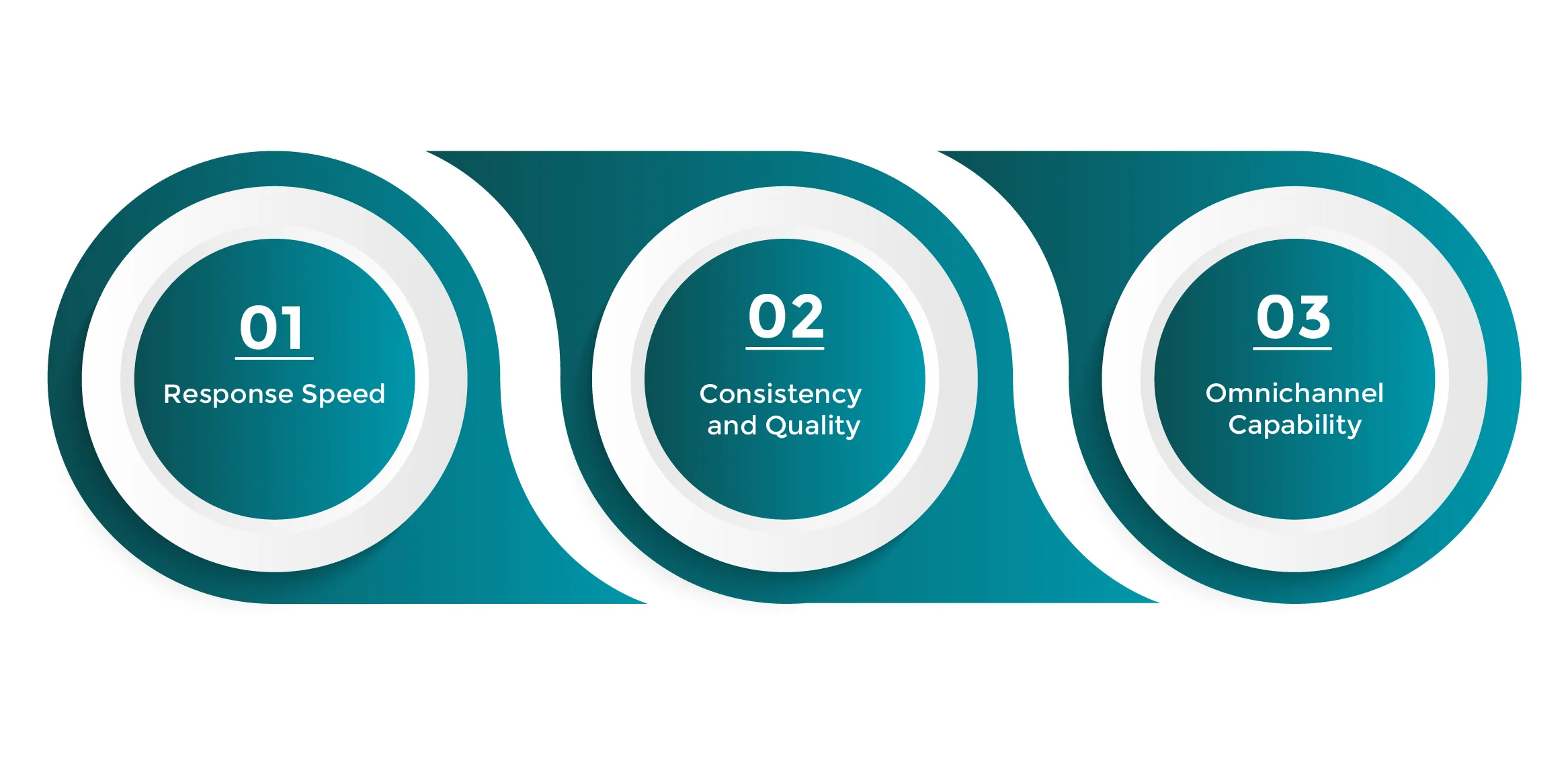
Response Speed
Customers in 2026 will be demanding near-instant reactions to their inquiries. They won’t be satisfied waiting till the next business day – rather, they will want their response right away, within seconds. A 2025 Salesforce State of the Connected Customer report highlighted that 83% of the customers expect an immediate response when they get in touch with a brand. By a wide margin, the report “Salesforce State of the Connected Customer 2025” indicates that more than 7 out of 10 customers will most probably change the company they deal with if they encounter only one instance of poor customer service. In fact the speed of customer response will determine customer’s retention.
Legacy BPO contact centers operate with structural limitations like queue size, agent availability, and shift coverage. Even high-performing BPOs sometimes manage the average speed to answer (ASA) on phone that ranges from 30 seconds to 3 minutes, and for email it can be several hours to a full business day.
AI contact centers can reply immediately and without interruption – around the clock, in all channels, and at the same time. When a machine is dealing with ten thousand conversations at once, there is no queue at all.
Consistency and Quality
Here is something none of the people working in a BPO will tell you directly: keeping the same level consistently is very difficult for human beings. For example, a worker who only had three hours of sleep will definitely interact differently than a person who is fully rested. In fact, a group of 500 employees located in five countries will bring in 500 different variations in the way they speak, accuracy, and empathy.
AI will give you the same high quality at 2 a.m. on a holiday weekend as it will at 10 a.m. on a Monday. The text won’t be changed. The tone will remain consistent. Also, with large language models, the replies can be very human-like, empathetic, and aware of the context.
Nevertheless, there are still some areas where AI does not perform as well. Difficult emotional scenarios, very technical resolving of problems, and completely new cases that are not part of the training data can even confuse well-tuned systems. Human escalation is still very necessary – but it is becoming a smaller and smaller portion of the overall volume.
Omnichannel Capability
Modern customers do not stay in one channel. They start on chat, switch to email, follow up on social media, and expect you to remember the full history when they call. This is the omnichannel promise – and it is genuinely difficult to deliver in a traditional BPO model.
AI contact center platforms are built for omnichannel by design. Every interaction feeds into a unified customer profile. The context is passed along smoothly from one channel to another.
What is more, marketing teams get a full view of a customer’s journey(360-degree), not just separate support tickets.
| Performance Dimension | Traditional BPO | AI Contact Center |
| Response Time (Chat) | Minutes to hours | Seconds |
| Response Time (Voice) | 30 sec – 3 min (ASA) | Instant (IVR + AI blend) |
| 24×7 Availability | High cost premium | Standard, no extra cost |
| Consistency of Quality | Variable by agent | Highly consistent |
| Omnichannel Support | Limited, siloed | Native, unified |
| Multilingual Support | Requires specialist agents | Real-time, 50+ languages |
| Peak Volume Handling | Requires advanced staffing | Elastic, instant scaling |
Why This Matters Beyond Customer Support
Marketing professionals, in case you are wondering why this aspect should be your main concern, here is the perspective for you: customer service and marketing cannot be considered two separate activities anymore. They are identical functions only seen at different stages of the customer’s lifecycle.
Customer Data as a Marketing Asset
Every time customers interact, they reveal their intentions, emotions, and satisfaction with products, as well as indicate their stage in the lifecycle. With the usual BPO model, most of such information gets stored in segregated call center reports or simply vanishes. Only a handful of BPOs offer you real-time, well-arranged access to the level of interaction data that can be linked back to your marketing platforms.
In contrast, AI contact centers are built around data. Each talk is recorded, identified, and can be dissected. You can figure out which product lines create the most confusion, which customer groups are most likely to churn, and which marketing messages produce leave those customers dissatisfied that lead to support tickets. Such knowledge is directly used for improving campaigns, creating content strategies, and developing customer journey maps.
Brand Voice and Personalization at Scale
Modern AI platforms give you the ability to craft and maintain a distinctive brand voice in every customer interaction. You can provide the system with your tone instructions, brand language, and customer profiles. This leads to a harmonious brand experience on a large scale – which is honestly quite challenging to keep up throughout a big, multi-site BPO operation.
Personalization has got a big boost too. AI technologies linked to your CRM can call customers by their first name, they can mention past conversations, they can predict the customers’ needs based on the purchase history, and lastly, they can customize the answers to the individual customer profiles – and all these are done in real time.
Customer Lifetime Value and Retention
Customer retention is affected in a directly proportional relationship by speed and quality of service resolution. Studies conducted by Harvard Business Review have continuously revealed that customers, who had a good service recovery experience, not only became more loyal but even stayed loyal more than those who had no problem at all. Achievements of AI contact centers, such as quickness, steadiness, and the ability to personalize, can produce a lot more service recovery chances than traditional BPO models that are limited by queue times and agent differences.
The marketing math: Increasing customer retention by just 5% can increase profits by 25% to 95%, according to research by Bain & Company. AI contact centers are a direct retention lever – and most marketing teams have not yet claimed ownership of that lever.
Which Model Works for Whom?
There is no universal answer here. The right choice depends on your business model, interaction complexity, volume, and strategic goals.
When a Traditional BPO Makes Sense
- High-complexity interactions that require human judgment, deep empathy, or regulatory expertise (e.g., legal services, medical support, financial advice)
- Businesses with irregular, unpredictable volumes where maintaining in-house infrastructure is impractical
- Markets where human connection is a core part of the customer value proposition
- Organizations with strong, existing BPO relationships and well-optimized processes
- Companies handling sensitive or highly regulated communication that requires human accountability
When an AI Contact Center Makes Sense
- Handling a large number of queries by customers, processing similar questions (order tracking FAQ password recovery, account update etc.)
- E-commerce SaaS fintech, and digital businesses which emphasize on providing instant and round-the-clock digital support to their customers.
- Companies that are experiencing rapid growth and as a result want flexible and cost-efficient solutions without resorting to time-consuming recruitment processes.
- Marketing-oriented firms that are seeking to directly connect their customer support data with their CRM and other analytics tools.
- Businesses that serve international customers and therefore need multilingual support at scale.
Businesses beginning with AI-driven support can rely on our customer service AI solution coupled with an AI support chatbot guide to show them how to create a simple and scalable on-ramp.
The Hybrid Model: Best of Both Worlds
In 2026, a lot of big companies will run a system where AI does Tier 1 tasks (like handling simple, common questions). However, there will be a small group of highly trained human agents – either working in the company or through a carefully chosen BPO partner – taking care of Tier 2 and Tier 3 escalations.
Such a method is very effective as it combines the cost-saving benefits of AI for most interactions with the human discretion and empathy necessary for complicated situations. In fact, more and more, it’s becoming the norm for customer experience units that want to be ahead of the curve.
| Business Profile | Recommended Model |
| E-commerce (high volume, digital-first) | AI Contact Center (primary) |
| SaaS / Tech Products | AI Contact Center + Human Escalation Tier |
| Financial Services (regulated) | Hybrid: AI for Tier 1, BPO/In-house for Tier 2–3 |
| Healthcare | Hybrid with a strong human oversight layer |
| Luxury / High-touch Retail | BPO-primary with AI-assisted tools |
| Startups (scaling phase) | AI Contact Center (cost-efficient, scalable) |
| Large Enterprise (legacy systems) | Phased hybrid migration over 12–24 months |
The Hybrid Model: Best of Both Worlds
Such a method is very effective as it combines the cost-saving benefits of AI for most interactions with the human discretion and empathy necessary for complicated situations. In fact, more and more, it’s becoming the norm for customer experience units that want to be ahead of the curve.
| Business Profile | Recommended Model |
| E-commerce (high volume, digital-first) | AI Contact Center (primary) |
| SaaS / Tech Products | AI Contact Center + Human Escalation Tier |
| Financial Services (regulated) | Hybrid: AI for Tier 1, BPO/In-house for Tier 2–3 |
| Healthcare | Hybrid with a strong human oversight layer |
| Luxury / High-touch Retail | BPO-primary with AI-assisted tools |
| Startups (scaling phase) | AI Contact Center (cost-efficient, scalable) |
| Large Enterprise (legacy systems) | Phased hybrid migration over 12–24 months |
Implementation Reality: What Nobody Tells You
Both models come with implementation considerations that vendor brochures tend to underplay. Here is the honest picture.
BPO Implementation Reality
Usually, onboarding a BPO partner is a 8 to 16 weeks project. During this time, you should do the following: knowledge transfer, training the staff, setting up a quality assurance system, and creating reporting workflows. Usually, the first 90 days introduce a downturn in performances as agents are being trained. Governing is continuous. To run the BPO relationship, carry out quality auditing, execute escalations, and adjust to new business needs, you must have dedicated internal personnel. Companies often fail to recognize this overhead requirement.
AI Contact Center Implementation Reality
Believe it or not, getting an AI contact center up and running can be done in a blink of an eye compared to what most people anticipate – however, it’s not as smooth as vendors often indicate. A company needs technical personnel and detailed plan because interfacing with your CRM, e-commerce platform, and existing telephony infrastructure is a bit complicated. Underestimating this part is the biggest blunder that companies make in their training and intent mapping phase. Remember, an AI is only as capable as the data and situations it is exposed to. Being stingy here will only result in low containment and unhappy customers at the very beginning of the rollout.
You should allocate time for a 30 to 90 day tuning phase during which the performance is tracked, the gaps in intent coverage are identified, and the responses are polished. Post this, a properly set up system keeps getting better on its own.
Expert perspective: According to Gartner’s 2025 Customer Service Technology Survey, organizations that invest in a dedicated AI training and optimization phase achieve 40% higher automation containment rates than those that deploy “out of the box” without customization.
5 Key Statistics That Define the 2026 Landscape
Numbers tell the story more clearly than any narrative. Here are five data points that frame the current state of AI contact centers versus traditional BPO operations.
- According to the IBM 2025 Global AI Adoption Index, 77% of customer service managers intend using AI-enabled contact center equipment as their main area of AI investment in business operations over the next 24 months.
- According to McKinsey’s 2025 State of AI report, by using AI in customer service, businesses can bring down the cost of a single interaction by as much as 70% in high-volume, routine-query scenarios.
- Forrester Research found that companies using AI for customer service reported a 15-20% improvement in CSAT scores within 12 months of deployment, driven primarily by speed and consistency improvements.
- According to Gartner’s 2025 poll, 73% of service chiefs view AI-based contact centers as a fundamental CX strategy vehicle, which is a significant increase from the 41% in 2021.
- Dell Technologies’ 2024 Global Tech Adoption Index reveals that 68% of the enterprises leveraging AI in the customer support domain achieve a 20-30% cut in the volume of the work handled by agents within the first 18 months of adoption.
Decision Framework: A Step-by-Step Guide
If you are trying to decide between these models – or determine how to evolve your current setup – here is a straightforward decision framework.
Step 1: Audit Your Current Interaction Volume and Mix
Type of interactions classification: routine (most probably can be automated), medium complexity (may be AI-assisted), and high complexity (requires human judgment). Automating interactions with AI is a very good option, if 60% or even more of the interactions are in the routine category.
Step 2: Calculate Your True Cost Per Interaction
Don’t be fooled by the BPO contract price alone. Also, consider the internal costs of oversight, quality assurance personnel, report making, and un-happy CSAT impact (customer churn, loss of brand image). This will provide you a clear picture of the actual expense, which you can then use to compare with the rates of AI platforms.
Step 3: Evaluate Your Data and Integration Readiness
The largest advantages of AI contact centers are experienced when they are tightly integrated with your CRM, marketing automation, and analytics platforms. First of all, check if the existing set of tools used by your company can support such integration. If it can, then the argument for the return on investment for AI gets considerably more robust.
Step 4: Define Your Non-Negotiables
Jot down the types of interactions, the rules for compliance, and the customer experience standards that should never be compromised. Some of these may need to be handled by a person even if AI is capable. These will help you decide your escalation level, either an internal team or a specialized BPO partner.
Step 5: Model the Business Case
Create a three-year financial plan laying side-by-side the expenses of your current BPO operations with a phased AI deployment one. You should factor in from the implementation costs to efficiency gains, to the CSAT-driven retention improvements, and data value. This business case will bring stakeholders together and get the budget approved.
Why Vsynergize AI BPO Stands Out as the Smarter Choice
Reading this comparison, it is obvious that the perfect solution is not only AI, or only traditional BPO. It is a model that intelligently combines the two – allowing AI to deal with scale and speed while human skills are used where judgment and empathy are most important. This is exactly the kind of thing that Vsynergize AI provides. You can see how Vsynergize’s AI BPO hybrid model is built for 2026 enterprises. With more than 20 years of customer experience know-how and a fully combined AI-powered BPO model, Vsynergize is at a unique crossroad that most providers just cannot match. Learn more about which BPO company offers the best AI services.
A Hybrid Model Built for the Real World
Vsynergize AI embraces a People+AI approach, not just writing it on their walls but working as a mainframe. Our AI programs take care of the high-volume, repeatable interactions at speed and scale, while the experts of CX teams located in four major countries (USA India Philippines, and Honduras) handle complex, high-stakes conversations that need a human touch.
This is no ad hoc chatbot attached to a call center. It is a thorough, end-to-end AI BPO that has been developed to provide tangible results across the whole range of customer interaction types.
The Vsynergize AI Product Suite
Vsynergize AI has developed an AI contact center as a cornerstone of its offering. The center is equipped with a proprietary suite of AI-based tools aimed at enhancing customer experience in the digital age.
- Angel X – This is an AI voice and web assistant that can recognize context, tone, and intention on the spot, thus offering conversations that sound human rather than mechanical.
- Angel Tel – This is a future-proof AI contact center platform that can manage very high calling volumes and maintain an excellent level of accuracy and consistency at all times and in all shifts.
- Angel Tech Support – This AI-driven technical support system is capable of not only identifying the problem but also solving it in multiple channels without the lengthy wait times given help through human interactions.
- AI Digital Mind – It is an AI-driven digital twin that is able to store and formalize the knowledge of an organization, permitting it to always provide expert-level answers even when producing large volumes.
Performance That Speaks Directly to ROI
The AI BPO model by Vsynergize AI is capable of producing results that directly match the measurement criteria decision-makers care about most. According to their platform, Vsynergize’s first-contact resolution rate is at 92%, their CSAT score is 4.8/5 and their clients who have switched from traditional BPO models to the AI-integrated approach have seen cost savings of up to 35%. These are not just forecasts. You can see how telecom companies use Vsynergize AI BPO to improve efficiency and reduce costs through process outsourcing.
Trusted at Scale – Across the Industries That Demand It Most
Vsynergize AI partners with clients mainly in the industries where customer experience is a major factor in driving revenues: Communication Media and Technology, Banking and Financial Services Healthcare E-Commerce, and Retail. They work with both Fortune 500 companies and rapidly growing mid-market businesses. Over 500 organizations have been transformed and more than 1,500 clients served worldwide.
That variety is a plus. Their AI systems have been trained on diverse, real-life interaction data from both regulated and unregulated industries so that clients are getting the benefit of a platform which has already experienced the complexity their business requires.
What Makes Vsynergize the Strategically Sound Choice
Most AI contact center vendors sell technology. Most BPO providers sell headcount. Vsynergize AI sells outcomes – and backs that position with a model that combines AI infrastructure, domain expertise, omnichannel capability, and 24/7 operational coverage under one roof.
Capability Traditional BPO Standalone AI Platform Vsynergize AI BPO AI-Powered Automation Limited Yes Yes — proprietary suite Human Expertise Layer Yes No Yes — across 4 global locations Omnichannel Support Siloed Native Native + unified CX Domain Experience Varies Minimal 20+ years Industries Served General General 6 specialized verticals Scalability Weeks to months Instant Instant with human backstop Marketing Data Integration Limited Yes Yes — full CRM integration If you are a business that desires the cost-saving capabilities of AI, the dependable human touch of the experienced staff, and the smart strategic link of customer service to marketing results, then Vsynergize AI BPO is the one that offers you all three – without making you give up any of them.
Vsynergize’s case studies available to the public illustrate the results obtained in the real world: a U.S. telecom client not only got an 8.0 CSAT score but also reduced average handle time by 25%. A wellness e-commerce brand experienced 17% increase in sales and 40% decrease in escalations. An insurance company, on the other hand, was able to shorten the claims processing time while at the same time, increase accuracy and throughput of their team.
Vsynergize AI BPO: 20+ years of CX expertise, purpose-built AI products, global delivery across 4 locations, and a proven hybrid model trusted by 500+ organizations worldwide. Visit 2026old.vsynergize.com to explore their AI BPO cost estimator and book a personalized demo.
Conclusion
It is not really a question anymore if AI contact centers function or not. They indeed function – and in the majority of high-volume, digital-first environments, they perform better and are more cost-effective compared to traditional BPO models at scale. But the question is more about where your new business is positioned on the spectrum, and how do you make a smart transition without disrupting customer experience at the same time?
Traditional BPOs still generate value in extremely complex, highly empathic, and strictly regulated environments. They are definitely not going away. However, they are changing – and those BPOs that will be really successful 2026 are the ones that have integrated AI tools internally for their own efficiency and competitiveness.
For CMO’s, the AI contact center is far beyond just a tool for cutting down costs. It is also a story about customer intelligence, brand consistency, and customer lifetime value. Each and every time that your AI interacts, this is the data making your subsequent campaign to be smart, your segmentation to be precise, and your retention of customers to be strong. Those companies that see this link between customer service touchpoints and marketing results are those that will have live competitive advantages in 2026 and beyond. A 2026 McKinsey analysis projects that AI‑driven CX functions will account for 30-40% of all customer service budgets by 2027, making now the strategic inflection point for most organizations.
The change is happening right now. The only thing to ask yourself is: are you the one starting it, or the one closing it?
FAQs
1. Can an AI contact center fully replace a traditional BPO?
Most companies avoid full swaps, they just don’t make sense. AI handles daily chats smoothly, day after day, without breaking stride. But when emotions run high or rules get tricky, humans still win. A mix works best in 2026: bots take the easy calls, people step in when things get messy. If one’s running their own team or hiring outside support, it comes down to how the business needs to stack up.
2. How long does it take to deploy an AI contact center?
Intents are mapped before any code runs, setting the stage for how responses form. With core needs met and CRM linked. Results delay by up to four months due to custom site issues. Personalized content and detailed analysis stretch delivery beyond six months. People end up needing more than just smart tools – they want a steady grasp of how things work.. Training shapes behavior more than hardware does. At least in theory, accuracy starts with how clearly goals are defined.
3. How do I measure the ROI of an AI contact center?
Measure ROI across four dimensions: cost reduction (cost per interaction before vs. after), efficiency gains (automation containment rate, handle time), customer experience impact (CSAT, NPS, first contact resolution rate), and revenue impact (retention rate improvement, upsell conversion from AI-assisted interactions). A 12-month post-deployment review comparing these metrics against your pre-AI baseline will give you a clear picture of true ROI.
4. What happens when an AI contact center encounters a query it cannot handle?
Modern AI contact center platforms use intelligent escalation routing. When the system identifies that a query exceeds its confidence threshold – meaning it cannot resolve the issue with sufficient accuracy – it seamlessly transfers the customer to a human agent, along with the full context of the conversation. The customer does not need to repeat themselves, and the human agent steps in with complete visibility into the interaction history. This escalation logic is configurable and improves over time as the AI learns from resolution patterns.
5. Is customer data safe in an AI contact center environment?
Data security is a legitimate and important consideration. Reputable AI contact center platforms comply with major data protection frameworks, including GDPR, CCPA, SOC 2 Type II, and ISO 27001. When evaluating platforms, review their data processing agreements, encryption standards (at rest and in transit), data residency options, and access control policies. Ensure the platform you select aligns with the specific regulatory requirements of your industry and the geographies you serve. Always conduct your own due diligence and involve your legal and compliance teams in the vendor evaluation process.






 Reduces response times by 50%
 Date: 19th February, 2025
 Time: 12 PM – 1 PM (EST)
 Where: LinkedIn Live