

Before we dive into the details, think of a mental model that can simplify things drastically. View Artificial Intelligence as the large umbrella. Beneath it, there is Machine Learning – a branch where machines learn by example rather than doing what is programmed. Under Machine Learning, there is Deep Learning, which employs multi-layered neural networks for deciphering complex features. And across all these segments, you have distinct types of models: generative models, reinforcement learning algorithms, natural language processing tools, etc.
They are nested, not competing. A generative AI model like GPT-4 is also a deep learning model. A recommendation engine is also a machine learning model. Understanding this hierarchy removes a lot of confusion.
Now, let us examine each type in detail.
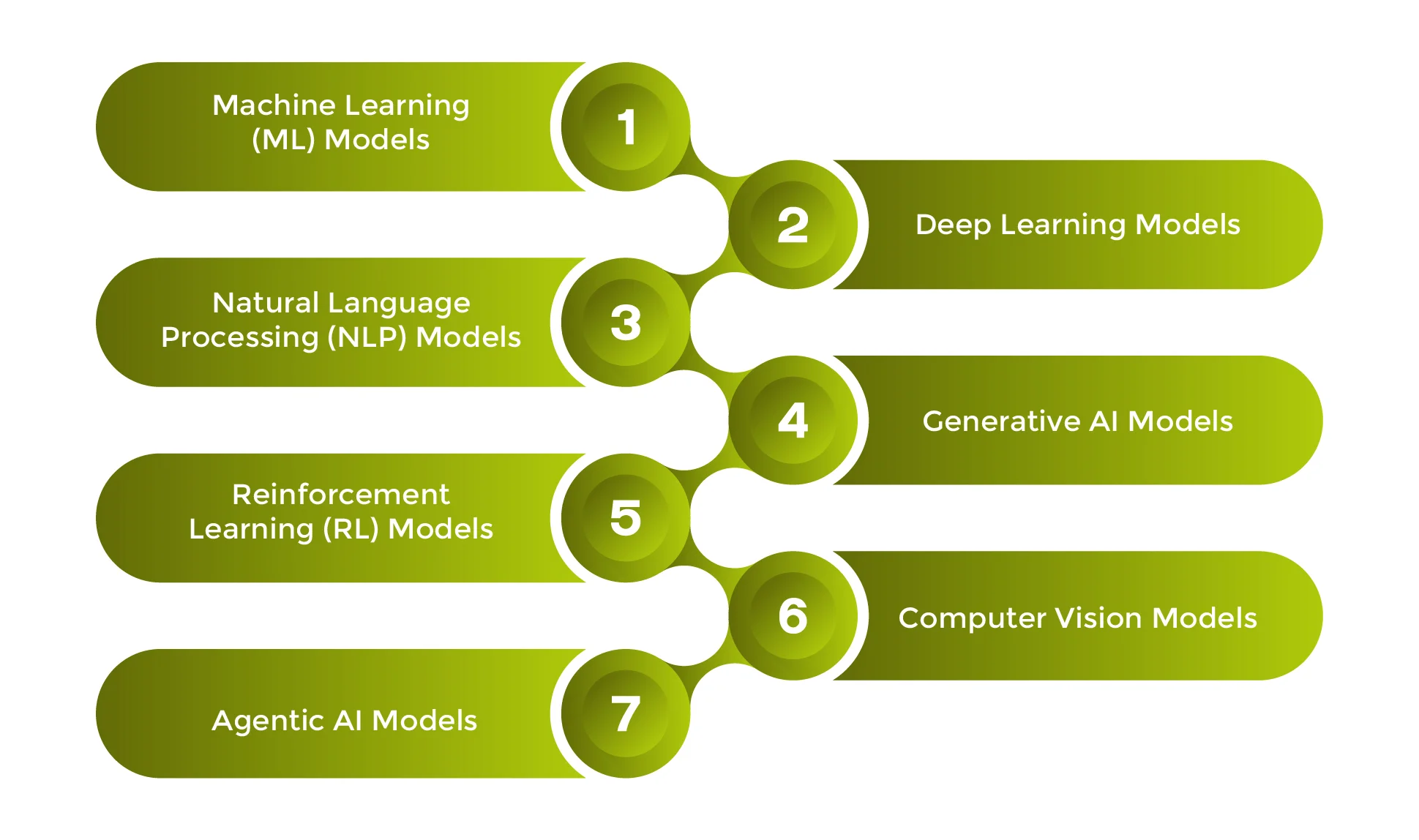
Machine Learning (ML) Models
What They Are
Machine learning models get their knowledge from past data. Providing them with examples, they find patterns, and then use those patterns to forecast or make decisions on new data without being explicitly programmed in every step.
Three major types are:
- Supervised Learning – The model learns from data that is already labeled (a pair of input and output). For instance, if you show that “this email got a 45% open rate” and “that one only 12%”, it will be “smart” enough to figure out which one will have a better result.
- Unsupervised Learning- This is when there are no labels. The model discovers the underlying structure in data by itself. Customer segmentation serves as a great illustration. In this case, buyers are segmented based on their behavior – users do not have to identify these groups in advance.
- Semi-Supervised Learning – A combination of labeled and unlabeled data. It’s a great tool when labeling is really expensive (which indeed is usually the case in enterprise scenarios).
What They Do in Marketing
ML models power most of the “smart” features in your current marketing stack:
- Predictive lead scoring – By mining CRM data, AI is capable of ranking leads by the likelihood of conversion. According to a report, AI-driven lead scoring has increased conversion efficiency by 31% over conventional methods as of 2025.
- Customer churn prediction – Models identify which customers are likely to leave, thereby initiating retention campaigns.
- Dynamic pricing – E-commerce platforms change their prices immediately when they get these signals from the market that demand is changing.
- Email personalization at scale – Machine learning models identify what is the right sending time, subject line, and content for every single recipient.
Best For
Any marketer who needs to act on patterns in existing data attribution modeling, campaign forecasting, audience segmentation, and conversion optimization.
Deep Learning Models
What They Are
Deep learning is machine learning with more layers. Literally. These models use artificial neural networks with multiple hidden layers (hence “deep”) to process highly complex data like images, audio, and natural language. Gartner predicts that traditional search volume will drop 25% by 2026.
They require large amounts of data and significant computing power. But in return, they produce results that simpler ML models simply cannot match — particularly in tasks involving perception and comprehension.
What They Do in Marketing
Deep learning powers many of the top AI applications in marketing we’ve all seen recently:
Image recognition for visual content moderation – Leveraging AI to automatically spot images that are off-brand or identify inappropriate user-generated content on various platforms.
Voice search optimization – It is the process of grasping spoken language queries profoundly to correctly detect the intent.
- Video ad performance analysis – It helps break down which visuals in a video ad lead to more engagement.
- Sentiment analysis in social listening – It is capable of working through thousands of social posts at the same time to figure out whether there is a change in how people view the brand.
Best For
Marketers who work with unstructured data – such as images, video, audio, or large text corpora. Are also a must for any brand that aims to operate on a large scale across many channels at the same time.
Natural Language Processing (NLP) Models
What They Are
NLP models are the best way to make machines understand, interpret, and generate human language. It is not just about recognizing words. It is about understanding contex,,t t, one meaning, and intent as well. Gartner says that over 33%+ of web content will be optimized for AI search by 2026. The development of modern NLP is quite significant. Previously, the systems were merely using rule-based logic (if this word appears, respond this way). Most modern NLP models, especially ones based on transformers, “read” language in the very same way humans do – they can figure out ambiguities, sarcasm, and context in a conversation. Gartner’s survey finds that 61% question info reliability; 68% question content authenticity; 50% prefer non-AI brands
What They Do in Marketing
Natural language processing (NLP) is probably the most important type of AI model for marketers in terms of direct impact:
- Content generation – For example, writing scripts for commercials, drafts for emails, descriptions of products, and posts for social media on a large scale would be the main activities.
- SEO optimization – Knowing the language spoken by your target audience and hence customizing your content to suit them is a very great idea.
- Customer support automation – Chatbots that can have a natural conversation with customers and solve their issues. According to Gartner, by 2029, agentic AI will be capable of solving 80% of typical customer service problems without the need for a human.
For a detailed cost breakdown, check our guide on call center technical support pricing.
- Survey and review analysis – Getting structured information from thousands of open-ended responses from customers within a few.
- Intent detection – Identifying whether a visitor is browsing, considering, or ready to buy – and serving content that matches.
The JPMorgan Chase Case
JPMorgan Chase introduced an NLP model to create various ad copy alternatives. Such AI-produced ads not only performed better than other alternative ads,s but one of them increased the click-through rate by 450% as compared to human-written ads. It’s more than a minor feature change. That is a category-level shift.
Best For
Any marketing department using language: writing SEO supporting customers, gathering market data, keeping track of brands, or creating campaign messages.
Generative AI Models
What They Are
Generative AI is the model type that captured the world’s attention – and for good reason. It is not simply data these models analyze, but content of various sorts that they generate: text, images, audio, video code, and synthetic data. Gartner Survey reveals 73% of marketing teams are using Generative AI (GenAI) in some capacity.
The most prominent generative AI architectures include:
- Large Language Models (LLMs) – GPT-4, Claude, Gemini, and similar systems that generate human-quality text.
- Diffusion Models – Used for image and video generation (Midjourney, DALL·E, Sora).
- Generative Adversarial Networks (GANs) – Two competing networks where one generates content and the other evaluates it, producing increasingly realistic outputs.
Generative AI spending alone reached $644 billion in 2025, up 76.4% from 2024.
What They Do in Marketing
This is where marketing workflows are changing fastest:
- Content at scale – Early adopters report content production time dropping by 30–50% thanks to AI.
- Personalized campaign assets – Creating unique creative variants for each audience segment, automatically.
- A/B testing – Generating dozens of copy or design variants and deploying them in rapid parallel tests.
- AI-powered PPC – Campaigns demonstrate 50% higher click-through rates and 30% better conversion rates compared to traditional campaigns (Contenu Agency, 2026).
- Video and image generation – From ad storyboards to product visuals, at a fraction of traditional production costs.
A Note on Accuracy
Generative AI is capable of generating misleading outputs – the term to describe this is “hallucination”. The latest and most effective models can even show hallucination rates as low as 0.7%. However, models that are most commonly and widely used still hover around the percentage of 2 to 5 percent (Vectara, late 2025). It remains very important for humans to review, particularly when it comes to claims, statistics, or content that with the brand.
Best For
Content marketing, creative production, personalization at scale, campaign ideation, and other marketing functions where speed and volume of output are important.
Reinforcement Learning (RL) Models
What They Are
Reinforcement learning operates on a completely different underlying concept than other AI models. Where other AI models are trained from a fixed dataset, an RL model learns by taking actions in an environment, receiving feedback (rewards or penalties), and changing its behavior to get the best long-term outcomes. It is like training a new hire through live experience rather than teaching them in the classroom, isn’t it?
According to McKinsey & Company’s research, approximately 75% of the total annual value that generative AI (GenAI) use cases could deliver falls across just four key areas: Customer Operations, Marketing and Sales, Software Engineering, and Research & Development (R&D).
What They Do in Marketing
RL models are the hidden power behind some of the smartest marketing optimization system examples:
- Bid optimization in programmatic advertising – The model is constantly making bid changes in real-time across thousands of ad placements to get the best return on investment within the budget.
- Dynamic content personalization – Showing visitors the right content based on their live behavior instead of past segments only.
- Email send-time optimization – Discovering the right time each subscriber is most willing to open the message.
- Customer journey orchestration – Guiding the buyers to conversion in the most efficient way by sequencing the touchpoints across different channels.
Best For
Performance marketers, growth teams, and operations leaders who are looking for AI systems that get better with each and every interaction are especially those that work in high-volume, high-frequency environments and require continuous improvement.
Computer Vision Models
What They Are
Computer vision models analyze and interpret visual data like pictures and videos, allowing them to understand what is represented. For instance, they can find objects, recognize faces, pick out text in images, study the layout of visuals, and categorize a large amount of visual content. Such models mostly rely on convolutional neural networks (CNNs), and more and more, transformer structures modified to handle images are being used. Gartner says that 60% of brands will be using agentic AI for 1:1 interactions by 2028. As per Gartner, 60% of brands will be using agentic AI for 1:1 interactions by 2028.
What They Do in Marketing
Visual marketing is a fast-growing application area:
- Visual search – Giving customers the option to look up through an image rather than text (Pinterest Lens, Google Lens).
- Brand monitoring – Identifying logo appearances and brand mentions in social media images, even if the images are not tagged with text.
- Ad creative analysis – Studies of the visual elements (color, face position, product shots) that are connected with greater user engagement
- Retail shelf analytics – Using computer vision to identify a product’s shelf placement as well as the presence and positioning of competitors.
- Video content moderation – An automated system for detecting inappropriate content in user-generated videos to ensure brand safety before publication.
Best For
E-commerce, retail, consumer brands, and any marketing team that manages a lot of visual assets and needs a data-driven insight into the effectiveness of visuals.
Agentic AI Models
What They Are
Agentic AI is the newest major category – and the fastest-growing one. Agentic AI models are capable of more than merely answering a single query. They articulate objectives, design step-by-step production processes, utilize extra instruments, and carry out intricate operations requiring little human involvement. Compare that to a calculator, for example, with an independent finance assistant, who tracks your accounts, finds irregularities, prepares documents, and keeps you informed, all without being asked, and those are only some of the things she can do. McKinsey says that 26-55% productivity gains; 3x more likely to redesign workflows.
According to Gartner, 81% of martech leaders are piloting AI agents.
What They Do in Marketing
Agentic AI is beginning to reshape how marketing teams are structured:
- Autonomous campaign management – Fully operating, supervising, and improving campaign activities independently without the manual control of every step.
- Research and competitive intelligence – Carrying out lengthy and complex web research operations, analyzing data, and drafting organized reports.
- Multi-channel outreach orchestration – Managing various modes of communication like emailing, SMS, and social interaction points based on customers’ live signals.
- Sales development automation – Detecting leads, making appointments, and drafting briefing notes for sales representatives.
McKinsey’s 2025 State of AI report states that companies that apply agentic AI for use cases related to revenue generation notice a productivity increase of 2655%.
Best For
This product will mainly be used by marketing and sales operations teams in large companies who want to reduce time-consuming manual work, speed up their sales process, and expand their business without hiring a lot of new people.






 Reduces response times by 50%
 Date: 19th February, 2025
 Time: 12 PM – 1 PM (EST)
 Where: LinkedIn Live