

Vsynergize

Enterprise Conversational AI: What It Is, How It Works, and Why It Matters

Enterprise-Conversational-AI
Profile

Dheeraj Agarwaal

FOUNDER & CEO,
VSYNERGIZE AI AND AI FACULTY

I help businesses transform the way they engage customers, scale operations, and drive growth through the power of Artificial Intelligence and human expertise.

Reach out to me for:
  • AI-Powered Customer Support & Voice Agents
  • Contact Center and Customer Experience Transformation
  • Lead Generation & Sales Acceleration Solutions
  • Recruitment Process Outsourcing (RPO) and Talent Acquisition
  • Digital Transformation & Process Optimization
  • Enterprise AI Strategy and Implementation

Key Takeaways

  • Enterprise conversational AI supports natural and intelligent human-like dialogues while automating customer and employee conversations massively.
  • It connects with company systems and relies on technologies like NLU, machine learning, and RAG to provide correct, personalized responses.
  • Businesses are leveraging it to enhance customer experience, optimize efficiency, cut down on expenses, and stimulate revenue growth.
  • Deployment success relies on excellent integration, data authenticity, robust security, and compliance systems.
  • With the advancement in AI, conversational AI will become an indispensable feature of corporate operations through autonomous agents and extremely personalized experiences.

Imagine a situation in which Tomer contacts your company will receive a prompt, accurate, and warmly personalized response, no matter whether it’s 2 AM, you know three languages, or your office is on holiday. Actually, that is not a glimpse into the far future times. That is a tool of enterprise conversational AI, which is up to the task and will be your friend. Another side of the story is that winning businesses like Vsynergize AI are using enterprise conversational AI now. On the flip side, for every company successfully launching it, there are plenty more that are still trying to figure out what exactly this innovation is. How does it work? And more significantly, does it bring about real business results, or is it just a costly experiment? 

This article completely addresses all those questions – it is simple, straightforward, and not the usual marketing jargon that most of this space is ridden with. It doesn’t matter if you are a CIO who is in the process of platform evaluation, a CMO who is considering customer engagement strategy, or an operations leader who needs to expand without increasing headcount; this is the site where you locate the information you need.

The global conversational AI market was valued at $13.2 billion in 2024. By 2030, it is projected to reach $49.9 billion – a compound annual growth rate of 24.9%. That is not hype. That is sustained, structural investment from enterprises that have seen the results firsthand.

Looking for a reliable AI as a Service Company?

Vsynergizer is there to help you.

What Is Enterprise Conversational AI?

Start with a simple distinction that changes how you think about the entire category. The chatbot is basically a lookup table with a chat interface. You enter a question, it uses keywords from your message to find a relevant script, and then produces a pre-written response. It is deterministic, very fragile, and can be quite annoying when your question deviates slightly from the known patterns that it has been programmed to recognize. Enterprise conversational AI is a totally different beast. It is an advanced, multi-level AI system capable of understanding language, keeping track of a conversation, reasoning through complex business processes, connecting to your enterprise data, and being able to do real tasks for both the user and the business. As per Gartner, 85% of CX leaders will pilot conversational GenAI in 2025

Imagine a simple chatbot as a vending machine; you can count on it to do one specific thing, and it will be of absolutely no help outside of that. Meanwhile, enterprise conversational AI is like a highly skilled customer success manager. This person knows your entire product catalog, has access to your CRM history with this particular customer, understands your return policy, and knows your escalation procedure, and in addition to all of this, they are also capable of dealing with the whole range of the conversation. Here is the explanation according to the textbook: Enterprise conversational AI is a kind of artificial intelligence platform that is specifically designed for large enterprises to create, manage,e and grow conversational automation in the customer-facing and internal environments. It uses a combination of natural language processing, machine learning, contextual reasoning, and enterprise system integration to create the illusion of a human-like conversation while at the same time automating the running of business operations that are quite complex, through intelligent automation in BPO.

1. Why the Word ‘Enterprise’ Matters

The term ‘enterprise’ does more than merely describe the size of a company. It also indicates a whole different level of requirements that the typical consumer-grade AI solutions do not fulfill. The AI used in enterprises has to be secure. That is because such AI systems manage personal identifying information of customers, financial data, medical records, as well as other business-related confidential information. Security measures cannot be merely an afterthought. Enterprise AI also needs to be compliant with relevant legislation. This will be HIPAA, GDPR, SOC 2, ISO 27001, PCI-DSS, or a combination thereof, depending on your sector. The solution must be capable of being audited, with comprehensive data lineage and access controls. The enterprise-level AI should be well-integrated as well. Your company is operating on a whole stack of systems, including CRM, ERP, HRIS, ticketing platforms, inventory management, and data warehouses. A conversational AI that is not able to interface with these systems may be able to provide answers to questions, but it would be unable to execute actions. And that is where the return on investment actually comes from. And finally, enterprise AI is expected to handle significant scale. Mere expansion of capacity is a somewhat insufficient strategy. Besides scaling capabilities, it should also support preserving the degree of quality, speed, and accuracy. A solution that is faultlessly executing 10,000 conversations a month should ideally be able to replicate its excellence at 10 million.

2. Enterprise vs. Consumer Chatbots: The Full Comparison

Capability

Basic Chatbot

Enterprise Conversational AI

Language Understanding

Keyword and pattern matching

Deep NLU with intent classification and entity extraction

Conversation Context

Single-turn interactions only

Multi-turn, stateful across sessions and channels

Personalization

Generic, scripted responses

Real-time, data-driven hyper-personalization

System Integration

Standalone or limited APIs

Native connectors to CRM, ERP, HRIS, and databases

Action Execution

Information delivery only

Bookings, updates, escalations, transactions

Security & Compliance

Basic or none

Enterprise-grade: SOC 2, HIPAA, GDPR, ISO 27001

Scale

Hundreds to thousands

Millions of concurrent conversations

Learning & Improvement

Static scripts

Continuous ML-driven improvement from real interactions

Voice Support

Rare, limited

Full ASR with multilingual, multimodal capability

Analytics

Basic volume metrics

Deep behavioral, sentiment, and operational insights

Looking for a reliable AI as a Service Company?

Vsynergizer AI is there to help you.

The Core Technology Stack: What Powers Enterprise Conversational AI

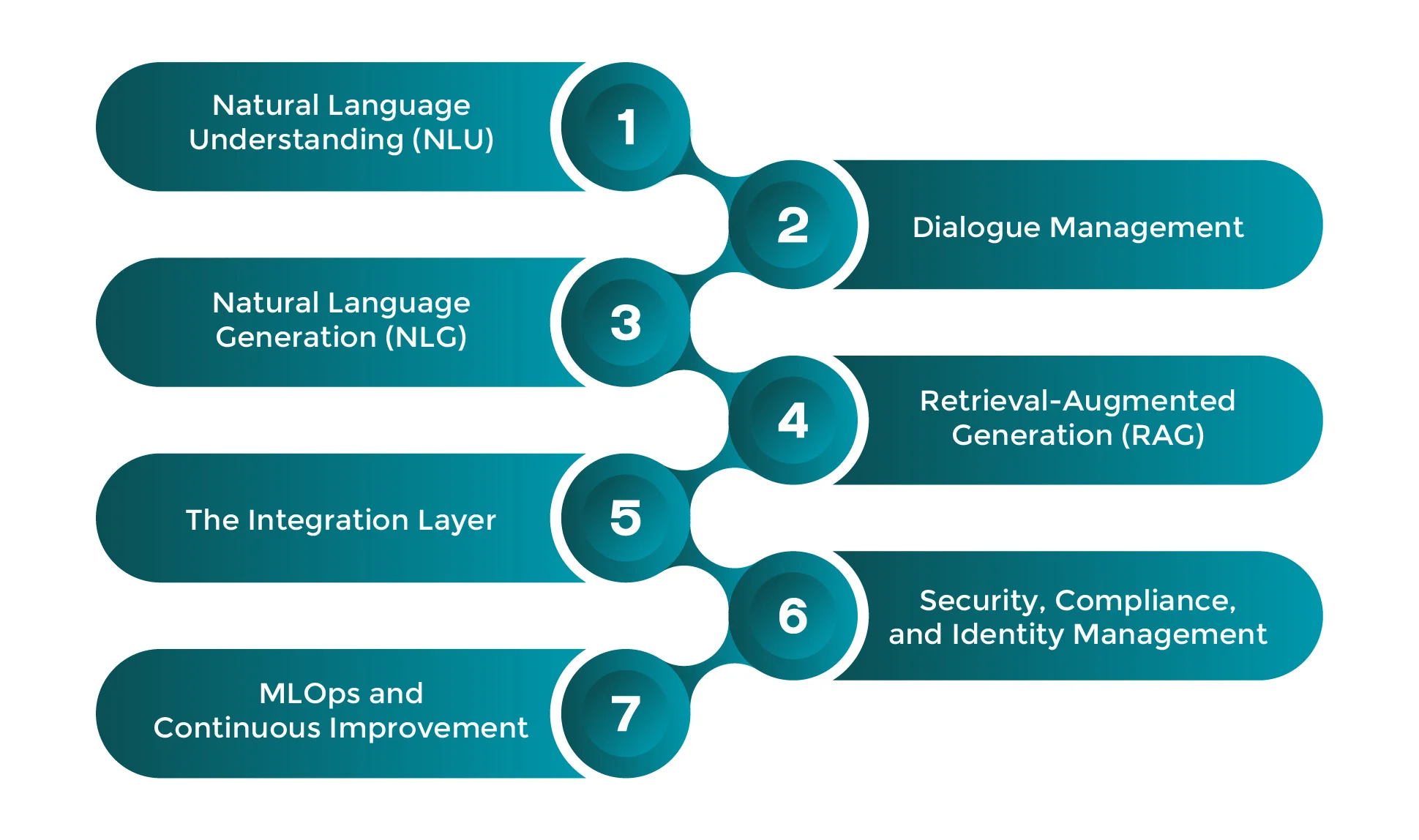
To make intelligent assessments of platforms and to provide your technical and leadership teams with accurate information, you must know what the system actually comprises at a fundamental level. Decision-makers cannot consider it as optional information. It is the basis of all conversations on buy vs. build, vendor evaluation, and implementation planning.
Core-Technology-Stack

1. Natural Language Understanding (NLU)

NLU is the main power source of a tool that can understand and read human language. For example, if a client writes the sentence ‘I want to change my delivery to Thursday, ‘ then the NLU engine should first identify the intent of the customer (changing order), then find the involved elements (delivery, Thursday), and after that, it will pass this well-arranged knowledge further to the dialogue manager. 

14% more issues resolved/hour with GenAI agents – McKinsey State of AI, 2025

Enterprise NLU goes deeper. It handles ambiguity, spelling variations, slang, domain-specific terminology, and multi-intent messages. A customer who writes ‘Can I get a refund and also check on my other order?’ is expressing two intents simultaneously. The NLU must capture both.

Likely, the quality of an enterprise conversational AI platform is mainly defined by how sophisticated its NLU is. If a platform is taught using data specific to a domain – your items, your rules, your industry’s jargon – it will give a very good performance compared to a general model, which can be used for the same tasks only in an efficient way.

2. Dialogue Management

Dialogue management acts as the mind of a conversational AI system. It keeps track of the entire status of a conversation – who said what, what steps were taken, what pieces of information are still necessary, and what the proper next response should be.

In a simple conversation, this is straightforward. In enterprise settings, it is not. A customer applying for a mortgage may interact across multiple sessions over several weeks. One session depends on the previous one. As the conversation goes on, a dialogue manager needs to keep track of the topic, make sure it does not repeat questions for the same piece of information, and change its responses depending on the stage the applicant is at in the process. 

Features like dialogue that remembers the state are the thing that sets conversational AI, which actually enhances customer experience, apart from those that just move the frustration of being in a phone queue to a chat interface.

3. Natural Language Generation (NLG)

If NLU is reading, NLG is writing. It transforms the AI’s intended response — pulled from data, policies, or knowledge bases – into natural, fluent, contextually appropriate language.

Enterprise NLG goes beyond template filling. It adjusts tone based on context. It incorporates dynamic content from real-time data. It respects compliance constraints – never promising something that the business cannot guarantee, and never sharing information that the user is not authorized to receive.

Maintaining brand voice consistency is a major NLG challenge for businesses. For example, a company with a warm and conversational brand voice for consumer interactions but formal and precise for enterprise customer communications will require an NLG layer that can suitably adapt to the segments. The top platforms consider this personalization a fundamental feature.

4. Retrieval-Augmented Generation (RAG)

This is one of the most important components in enterprise conversational AI and the one most frequently underexplained in vendor pitches.

Without RAG, a large language model generates responses based entirely on its training data. That training data has a cutoff date. It does not know your current pricing. It does not know that your logistics partner changed last quarter. It does not know about the product recall that went live yesterday.

One way that RAG addresses this issue is by integrating the language model with various live knowledge sources. These sources could be your internal documentation, product database, CRM knowledge base, or policy library. For example, when a user raises a question, the system pulls the latest pertinent information from these sources and incorporates it into the response. The practical impact is enormous. RAG-enabled systems give accurate, current answers. Systems without RAG hallucinate – they generate plausible-sounding but factually wrong responses. In a customer-facing enterprise context, hallucinations are not a minor inconvenience. They are a reputational and legal risk.

RAG is the feature that transforms conversational AI from a liability into a strategic asset. Without it, the AI guesses. With it, the AI knows. For enterprise deployments, this distinction is non-negotiable.

5. The Integration Layer

Conversations are valuable. Conversations that trigger actions are transformative.

The integration layer links the conversational AI with your business systems, such as CRM, RP, HRIS, order management, ticketing, payment processing, and inventory. It is this link enabling a conversational AI to do more than just answer questions. It can update a customer record. It can process a refund. It can book an appointment. It can flag an account for review. It can initiate a workflow that involves multiple systems and stakeholders.

According to enterprises, having a robust layer of integration, they get much higher return on investment from the conversational AI deployments mainly because the AI not only has conversations, but also takes actions.

6. Security, Compliance, and Identity Management

For their security measures, enterprise platforms offer encryption not only when the data is stored but also when it is being transmitted, controls on who can access what according to their roles, possibilities of data location, and detailed records of all activities. Identity and access management (IAM) ensures that users can only access information and capabilities to which they are authorized.

For regulated industries, the compliance architecture is not optional infrastructure it is a deployment prerequisite. Conversational AI that complies with HIPAA for a health system will have a very different architecture than a retail deployment, including a few extra layers of protection for PHI handling, audit logging, and data retention policies.

7. MLOps and Continuous Improvement

Enterprise conversational AI is not a one-time implementation. It is a living system that improves over time — or degrades, if it is not properly maintained.

MLOps (machine learning operations) pipelines and LLMOps (large language model operations) pipelines manage training, evaluating, deploying, and monitoring a model, as well as retraining the model based on data coming from real-world interactions. Enterprises that make strong MLOps practices a core part of their investment experience will experience continuous improvement of their conversational AI, and it will be able to handle more and more intents accurately as time goes on.

Companies that view conversational AI as a one-time implementation solution end up seeing the opposite result: the accuracy gradually diminishes as the language of customers changes, new products are released, and business processes are updated.


How Enterprise Conversational AI Is Used: A Marketing Perspective

Marketing is, at its core, a conversation discipline. It has always been about reaching the right person with the right message at the right moment. Generative AI (GenAI) agents have been the main catalysts behind great productivity improvements in the customer service sector, as per McKinsey’s “State of AI: Global Survey 2025” and related studies. Respondents even reported that they were resolving 14% more issues per hour.

Enterprise conversational AI scales that discipline to a previously impossible level – and makes it genuinely two-directional.

Here are the applications that are delivering measurable marketing outcomes right now:

1. Lead Generation and Qualification at Scale

Traditional lead capture is passive. A form sits on a landing page. The visitor either fills it out or does not. The conversion rate is what it is, and the leads that do come through are often cold by the time a rep follows up.

Conversational AI transforms lead capture into an active, personalized dialogue. A visitor landing on a pricing page is not presented with a static form. They are engaged in a conversation that qualifies their needs, answers objections in real time, and routes hot prospects to a sales rep within seconds — with full context on what was discussed.

What you get is a shorter period in which to make a sale, a better-caliber pipeline, and salespeople who are mostly engaged in closing deals, instead of doing the cold qualifying of leads by themselves. A study showed that companies using conversational AI for initial lead qualification have enhanced their sales pipeline quality by 15% to 50%, depending on the extent of their AI implementation.

2. Personalized Customer Journeys

Modern customers do not want to be treated like a segment. They want to be treated like individuals. Enterprise conversational AI makes that possible at scale. According to McKinsey, 71% higher retention for personalization leaders

Conversational AI, using live data sourced from CRM, behavioral analytics, and purchase history, can help make each individual’s experience so personal that it feels tailor-made. For example, if the customer who has previously shopped at the store drops in again, the system will be able to greet them by name as well as know what their last 3 activities were. Someone who is just a potential customer and has gotten the whitepaper on a certain topic will receive the follow-up that is directed to this specific interest. A customer leaving the cart empty yesterday will be in touch through a proactive talk that pinpoints the most common issues at this stage.

This level of personalization was previously only possible with dedicated account management. Enterprise conversational AI delivers it at the scale of your entire customer base simultaneously.

3. 24/7 Customer Engagement Without Additional Headcount

The economics of human customer engagement have a ceiling. To increase customer service, sales,s or success coverage,ge you have to hire more staff. But hiring more staff entails a higher wage bill, extra induction time, a greater time devoted to the administration and supervision, and also a higher likelihood of inconsistency in the quality.

To increase customer service, sales,s or success coverage, you have to hire more staff. But hiring more staff entails a higher wage bill, extra induction time, a greater time devoted to the administration and supervision,n and also a higher likelihood of inconsistency of the quality.

Enterprise conversational AI removes that ceiling. A deployment that handles 10,000 conversations per month can handle 10 million with infrastructure scaling — not headcount scaling. The marginal cost of an extra conversation is almost zero. For global companies, this is even more attractive. A business dealing with customers in 12 different time zones will not have to keep teams working in all 12 time zones in order to deliver quick service. The AI is capable of delivering a steady and top-notch interaction all day, every day, and the human intervention during working hours is only for those cases that really require it.

4. Post-Purchase Engagement and Retention

Customer acquisition is expensive. Customer retention is where margin lives. Enterprise conversational AI creates systematic post-purchase engagement programs that would be impossible to execute manually at scale.

Proactive check-ins after purchase. Personalized usage support depending on the product a customer has purchased. Sending notifications to renew the subscription while including a contextual appeal to the customer’s value. Re-engagement campaigns for lost customers that are triggered by behavior changes. That is not what we usually call campaigns – they are really the conversations, starting the right moment, so individually personalized and even able to change depending on the customer’s reaction.

5. Voice of the Customer Intelligence

Every conversation an enterprise conversational AI has generates data. Not survey data, which reflects what customers say when asked. Conversational data, which reflects what customers actually say, ask, and care about when they are engaging with your business on their terms.

At scale, this conversational intelligence is a competitive asset. It prevents potential product crises by finding those new product problems that most people haven’t even realized yet. Before you can lose any deals, it will point out the objections that will make you lose. It will also show the kind of words that your customers use to express their needs – words which should be reflected in your advertisements, your sales training, and the directions that your products are taking. Teams that use data from conversational AI outperform those that depend solely on surveys and focus groups. The ratio between signal and noise is just so much better.

Enterprise Conversational AI in Action: Industry Applications

The versatility of enterprise conversational AI is one of its defining characteristics. The same underlying technology adapted with domain-specific training, appropriate integrations, and industry-specific compliance configurations delivers value across sectors that look very different on the surface.

1. Retail and E-Commerce

Retail was among the first industries to implement conversational AI on a large scale, and there is no doubt that the move was justified. The number of customer interactions in retail – product queries, order details, returns, and personalized recommendations – is an exact reflection of the capabilities of conversational AI.

AI engages shoppers in natural conversation to understand their preferences and suggest relevant products, resulting in an increase in average order value and conversion rates.

Dynamic product recommendations:

  • Automated handling of order tracking, modification requests, cancellations, and returns –  fully integrated with order management systems. Order lifecycle management:
  • Conversational AI can notify customers if the items they want are back in stock or if they are on sale. Proactive inventory notifications:
  • Automated follow-up conversations that encourage product reviews, pinpoint customer dissatisfaction issues that could lead to product returns, and expose relevant cross-sell opportunities.

Post-purchase experience:

Major retailers using enterprise conversational AI report significant gains in customer satisfaction alongside cost reduction. The combination of higher engagement quality and lower per-interaction cost creates a compelling financial case.

2. Financial Services and Insurance

Financial services present a unique combination of high interaction volume, strict regulatory requirements, and significant customer value per interaction. 

46% of financial institutions report improved CX from AI – NVIDIA, 2024. 

Enterprise conversational AI addresses all three dimensions simultaneously.

  • Guiding applicants through document requirements, pre-qualification questions, and application status updates dramatically reduces time-to-decision. 
  • Loan and mortgage origination support: By four automated steps and in one conversational interaction, first-notice-of-loss messages for insurance claims are automatically resolved, required information is obtained, and the claimant is routed with full context to the appropriate adjuster.
  • Claims intake and processing: As per regulatory requirements, AI agents with natural language processing capabilities assist customers in finding answers to their account, product, and financial need-related questions with the help of personal profiling, transaction history, and multiple scoring models.
  • Personalized financial guidance: Conversational interfaces that flag anomalous patterns in customer interactions for human review, adding an intelligence layer to fraud prevention.
  • Fraud detection support: The compliance architecture for financial services deployments is more complex than most sectors, but the ROI is also higher driven by the high value of each customer interaction and the high cost of manual processing.

3. Healthcare

Among all the different industries, healthcare conversational AI deployments act in accordance with the conformity requirements at the highest level – US HIPAA, European GDPR, and so on. The chance to enhance patient experience and in-house efficiency is quite big if such restrictions are considered.

  • Conversational gathering of patient symptoms, past illness history, and insurance details pre-appointment, which results in lessening the paperwork for clinical employees. Also, patient intake and triage.
  • With the help of artificial intelligence, the scheduling of appointments with healthcare providers is done automatically, taking into consideration their complex availability.
  • Automated check-ins after hospital stays or procedures, monitoring for complications, medication adherence, and post-discharge follow-up.
  • AI that assists clinicians in real time by transcribing conversations, suggesting documentation entries, and flagging completeness gaps, along with Clinical documentation support.

4. Human Resources and Internal Operations

Not all enterprise conversational AI faces outward. Internally, some of the highest-ROI implementations are first and foremost ones that a company would use to improve the employee experience, to make HR processes faster, and to free HR, IT, and operations staff from the administrative work.

  • New hire conversational journeys that deliver information, collect required documentation, answer questions, and track completion without requiring HR staff time for routine interactions.
  • Password resets, software access requests, and common technical issues are handled conversationally, with escalation to human agents for complex problems.IT helpdesk automation
  • Employees get accurate, consistent answers to benefits questions, leave policies, and HR procedures — without waiting for an HR representative.HR policy and benefits guidance
  •  Conversational facilitation of performance review processes, compliance training acknowledgments, and policy attestations.Performance and compliance workflows.

5. Manufacturing and Field Services

  •  Field technicians access step-by-step repair guides and equipment documentation through voice-enabled conversational AI while their hands are occupied. Maintenance and troubleshooting guidance:
  • Procurement teams manage supplier communications, track orders, and resolve exceptions through conversational interfaces integrated with supply chain systems . Supply chain coordination:
  • Workers report safety observations and near-miss incidents through conversational interfaces that automatically route reports to the appropriate team. Safety incident reporting:

The Business Case: Measuring ROI from Enterprise Conversational AI

Technology investments need to justify themselves financially. Enterprise conversational AI is no exception and the good news is that it has a track record of doing exactly that.

The ROI story has two sides: cost reduction and revenue generation. The most compelling deployments deliver on both simultaneously.

1. Cost Reduction Metrics

The most direct cost impact is in customer service and support operations. When conversational AI handles 70% to 80% of inbound interactions without human involvement, the cost per interaction drops dramatically. For enterprises handling millions of interactions annually, this arithmetic is significant.

Not sure what those savings could look like for your business? Use our BPO Cost Estimator to get a quick, realistic cost breakdown.

Beyond volume reduction, conversational AI improves the quality of human interactions by ensuring agents receive full context, relevant history, and recommended next actions when escalation occurs. Average handle time for escalated interactions decreases because agents are not starting from zero.

Metric

Typical Pre-AI Benchmark

Post-AI Deployment Benchmark

Cost per Interaction

$5–$15 (human-handled)

$0.50–$2.00 (AI-handled)

First Contact Resolution Rate

65%–75%

80%–90%

Average Handle Time (Human)

6–9 minutes

3–5 minutes (with AI context)

Customer Wait Time

2–8 minutes

Under 30 seconds

Agent Utilization

60%–70%

80%–90% (on complex cases)

Conversation Containment Rate

N/A

65%–85%

2. Revenue Generation Metrics

The cost side of the equation gets most of the attention. The revenue side is where the bigger opportunity often lies.

Conversational AI in sales and marketing contexts drives measurable revenue impact through faster lead response (studies consistently show that responding to a lead within five minutes versus one hour increases qualification rates by up to 400%), higher conversion rates from personalized engagement, increased average order value from contextual cross-sell and upsell, and improved retention from proactive post-purchase engagement.

The organizations that realize the highest ROI from enterprise conversational AI are typically those that deploy it not just in service contexts but across the full customer lifecycle – from initial awareness through retention and expansion.

Key Implementation Considerations

Simply picking the right technology will not ensure that an enterprise conversational AI initiative succeeds. In fact, the companies that regularly say that they have achieved excellent results are the ones implementing the same set of practices that one should know before starting the project. Research from McKinsey State of AI, 2025, says that 78% of orgs are using AI in at least one function.

Define Success Before You Define Requirements

By far the most common deployment error is going into the technology evaluation phase before knowing exactly what success means to you. What are the precise business results that you want to obtain? Which indicators are the most appropriate ones to measure those results? What is the starting point or baseline that you are comparing your results against?

Without this foundation, implementations drift. Scope expands. Stakeholder alignment fractures. And when results come in, there is no agreed standard against which to evaluate them.

Define three to five KPIs before your first vendor conversation. Build your evaluation criteria around those KPIs. Evaluate vendors on their ability to help you move those metrics, not on feature lists.

1. Integration Planning Is Not a Phase Two Activity

The connection layer, linking your conversational AI with CRM, ERP, HRIS, and other enterprise systems, is actually what makes action-taking possible. Action-taking is the source of ROI. If you consider integration as a Phase Two activity, you will be launching a system only capable of having conversations but not finishing them.

Map your critical system integrations before deployment begins. Start by identifying the data flows that matter most. Make sure that the integration needs are part of your RFP and vendor evaluation. The systems that provide pre-built connectors and great integration capabilities will significantly lower your time-to-value.

2. Data Quality Determines Response Quality

Enterprise conversational AI is only as good as the data it has access to. If your CRM is filled with duplicate records and incomplete fields, the AI will surface that poor data in customer conversations. If the product knowledge base you use is out-of-date, the AI will end up providing customers with outdated info. Fixing data quality issues might not be a very attractive job; however, it is regularly the factor that distinguishes a conversational AI implementation that wows customers from one that makes new complaints. Examine the essential data resources you have before the launch and come up with a remediation plan for the biggest gaps in terms of conversation quality.

3. Organizational Alignment Is the Hardest Part

It is people and process alignment that cause technology to come at a success or failure drastically more times than technology fails them. Enterprise conversational AI is interconnected with customer service, e-marketing, ng sales, IT, legal compliance, and HR. Each of these teams has a say in the design of the system, its capabilities and limitations, and how success is quantified.

Engage stakeholders early. Establish governance frameworks that define ownership and decision rights. Build escalation procedures that human teams actually trust. Also, clearly inform employees whose roles might be altered that conversational AI will not replace good customer service staff; rather, it is releasing them from mundane tasks while they get the chance to perform the ones that really need human judgment.

Looking for a reliable AI as a Service Company?

Vsynergizer AI is there to help you.

Future Trends: Where Enterprise Conversational AI Is Heading

Technology is evolving way quicker than most enterprise planning can keep up with. Getting to grips with the direction it is heading lets you be smarter about your platform choices now – platforms based on architectures that can handle the features of the future, not only today’s needs.

1. Autonomous AI Agents

The current generation of enterprise conversational AI responds to requests. The next generation initiates them. 

Autonomous AI agents continue to watch the systems, figure out the situation, decide, and act even without a human giving the order. For example, imagine an inventory management agent that senses a low stock and, without human intervention, starts the purchase talk with the vendors who are already on the approved list, while a customer success agent spots the signs that a customer is likely to leave and then gets in touch with the customer,r offering a retention deal. Similarly, a compliance agent is always on the lookout for communications that appear to be against the policies and starts the workflows to fix the situation. 

Gartner predicts that by 2027, more than 50% of enterprises will have deployed autonomous agents managing end-to-end business workflows. The organizations building toward this capability now will have a multi-year advantage over those that start later.

2. Multimodal Conversational AI

Text and voice are not the end of the story. The enterprise conversational AI of the future will use. ing images, videos, and documents as inputs and combining them with conversation flows will be its ability. Gartner predicts that 80% of enterprise software will be multimodal by 2030

A field service technician, for example, could take a photo of a piece of malfunctioning equipment and then ask what is wrong. A customer who photographs product damage and initiates a return claim. A financial advisor’s client who shares a document and asks for an explanation of specific clauses. Multimodal capability transforms conversational AI from a channel into a genuine collaboration interface.

3. Domain-Specific Foundation Models

General-purpose large language models are extraordinarily capable. But they are being outperformed in specialized enterprise contexts by models trained specifically on domain data.

BloombergGPT for financial services. Med-PaLM for healthcare. Legal-specific models trained on case law and contracts. Such domain-specific foundational models show that using industry-specific training data significantly enhances the quality of results for specialized tasks. It is also predicted that the enterprise conversational AI market will split over the next three years into general-purpose platforms for broad coverage and domain-specific models for high-value specialized applications.

4. Explainable AI and Regulatory Compliance

Conversation AI is getting involved in decision-making processes with increased stakes, such as loan pre-qualification, insurance evaluation, healthcare triage, and the capacity to rationalize why the AI provided the answer it did, which is turning out to be a regulatory requirement and not only a nice-to-have feature.

Explainable AI (XAI) frameworks are being integrated within enterprise platforms to generate a type of documentation that shows the chain of logic behind AI decisions and is ready for audits. For enterprises in regulated industries, XAI capability will become a procurement requirement rather than an evaluation differentiator within the next two to three years.

5. Hyper-Personalization Powered by Real-Time Data

The personalization capabilities of today’s enterprise conversational AI are impressive. Tomorrow’s will feel like science fiction by comparison.

Real-time integration with behavioral analytics, purchase data, life event signals, and third-party data providers will enable conversational experiences so precisely calibrated to the individual that the line between AI interaction and expert human interaction will blur significantly. Banking institutions are already demonstrating this with virtual financial advisors that provide genuinely useful, individualized guidance not generic advice with a customer’s name inserted.

How to Evaluate Enterprise Conversational AI Platforms

The market is flooded with lots of different sellers who all make quite similar claims. So, to get to the real issues, you will have to come up with a judgment framework after your business setting that is very strictly made. 

1. The Five Questions Every Evaluation Should Answer

  • Capacity to take action is compromised right from the start if the platform is not able to connect your CRM and core operational systems through pre-built connectors or well-documented APIs. Does it integrate with our critical systems?
  • Ask vendors to demonstrate performance on actual use cases from your industry, using your actual terminology. Generic demos with generic use cases tell you very little. How does it handle domain-specific language?
  • How does the platform ground responses in your actual data? How frequently is that data refreshed? What happens when the knowledge base has a gap? What does the RAG architecture look like?
  • Request documentation on certifications, data handling practices, audit capabilities, and how the platform has handled compliance requirements in your specific industry. What does the security and compliance posture look like?
  •  How does the platform get better over time? What MLOps capabilities are included? How do you provide feedback that trains the model? What does the improvement trajectory look like?

Evaluation Criterion

What to Look For

Red Flags

NLU Accuracy

Domain-specific training capability, intent accuracy metrics from comparable deployments

Only generic benchmark results, no domain customization

Integration Depth

Pre-built connectors to your core systems, documented APIs, bidirectional data flow

Integration as a professional services engagement only

RAG Implementation

Live knowledge base connectivity, refresh frequency, and source attribution

Static knowledge base, no update mechanism

Compliance Architecture

Relevant certifications for your industry, documented data handling policies

Compliance is described as ‘in progress’ or not addressed

Improvement Mechanisms

Active MLOps pipeline, feedback loops, model versioning

No stated process for ongoing model improvement

Vendor Stability

Enterprise client base, funding stability, and implementation support model

Small client base, unclear implementation support

Conclusion

Enterprise conversational AI is not an incremental improvement to how businesses communicate with customers. It is a structural shift in what is possible. The organizations that understand this technology deeply – how it works, where it creates value, what it requires to deploy successfully – are building advantages that compound. Every conversation their AI has is data. Every improvement cycle makes the system more accurate. Every successful automation creates capacity for higher-value human work. The gap between leaders and laggards in this space widens over time.

For marketing leaders, the opportunity is to close the gap between the personalized, responsive, always-on experience customers want and the experience that human teams alone can realistically deliver. Enterprise conversational AI is how that gap gets closed at scale, sustainably, and with measurable financial return.

For technology decision-makers, the opportunity is to build a conversational AI capability that integrates deeply with enterprise systems, improves continuously, and scales without adding proportional cost. The platforms that enable this are commercially available today. The question is not whether this technology is ready. It is whether your organization is ready to move. 

Don’t just experiment with AI, build a system that drives real revenue and efficiency.

Contact us to see how enterprise conversational AI can transform your operations.

The customers who will define your competitive position over the next five years are already forming opinions about the companies that treat them as individuals and the companies that do not. Enterprise conversational AI is how you earn – and keep – the right standing.

The organizations moving on to enterprise conversational AI now are not experimenting. They are building a durable, competitive infrastructure.

Don’t just experiment with AI, build a system that drives real revenue and efficiency.

Book a 30-min strategy call to see how enterprise conversational AI can transform your operations.

Every month of inaction is a month of compounding advantage given to competitors who started earlier.

FAQs

1. What is the difference between a chatbot and enterprise conversational AI?

Standard chatbots operate only on the basis of pre-coded scripts and a few specific keywords to trigger their responses. Therefore, if a user says something that the chatbot’s script does not cover, not only would the chatbot not get it, but the user wouldn’t get any response either. On the contrary, enterprise conversational AI, through top-notch natural language understanding, contextual dialogue management plus machine learning (ML), is capable of handling open-ended, multi-turn conversations with users about a wide range of topics/intentions. Besides that, enterprise conversational AI not only takes real actions, but also keeps the context of conversations across sessions, changes according to the individual user, and, based on real interaction data, continuously gets better. Based on their functionality and features, the difference between the two is so large that one can easily categorize them as different types of products.

The deployment timeline varies from project to project, from the extent of integration in the solution to the organizational readiness. For example, a focused single-channel rollout, such as auto-customer service, can have its live version in about six to twelve weeks, if the team is quite ready and the platform already contains pre-built connectors. Rollout of the first launch phase of enterprise-wide deployments that involve multiple channels, use cases, and system integrations usually ranges from three to six months, with further expansion happening after the launch. Those organizations that underestimate the complexity of integration and the preparation of data will definitely experience a delay in their timelines. Getting strong and proper vendor implementation support will help you save a lot of time in these cases.

Regulated industries require that leading enterprise conversational AI platforms be designed from the ground up with compliance built in, rather than having it added later as a kind of afterthought. Depending on which sector one is talking about, relevant certifications might be SOC 2 Type II, ISO 27001, HIPAA, GDPR, and PCI-DSS. Enterprise-grade platforms feature On-the-fly encryption, granting permissions to persons on the basis of roles, systematic recording of all activities, options as to where data can be stored, and policies on data retention and disposal that are well documented. Enterprises that operate in the healthcare, financial services, insurance, and legal sectors have been able to successfully implement enterprise conversational AI within these frameworks. A vital component of thoroughly investigating is also ensuring that a vendor’s compliance statements are in writing, have been reviewed by an auditor, and are up-to-date,e not just being spoken.

Today’s enterprise platforms come with built-in functionality that not only supports multiple languages but also regional dialects, with certain systems even recognizing a user’s language choice on their own and changing the language used during the conversation if the situation calls for it. On top of this, voice-activated devices offer unique features of each language, such as rhythms, pitch, and even the use of phrases that meet the cultural standards, i.e., they do not stop at mere translation and go all the way to actual localization. As a result, a multilingual skill set is just one of the evaluation criteria that international businesses consider as a minimum when sourcing a solution, especially if they are serving a large catchment of different kinds of customers worldwide. Indeed, since the extent of the provision differs from platform to platform as well as language to language, those enterprises having certain language needs should definitely require language-specific results to be shown through various deployment scenarios for them to compare.

The most valuable ROI indicators actually pervade both cost and revenue dimensions. On the cost side: the number of complaints contained without going to refund, the costs per contact, the percentage of issues solved at first contact, the average time spent by a human agent on redirected conversations, and the agents’ level of productivity are the top ones. On the revenue side, it is lead qualification rate, lead response time, and conversion rate through AI-helped interactions that matter. Besides these, the average order value in the case of conversational commerce and the customer retention rate before and after the solution are some important metrics. Besides, long-term ROI measurement should take into account the strategic value of conversational data as the main source of customer intelligence that leads to product development, marketing strategy, and operational improvement.

Hi, I’m Jayashri Dalwi, a Subject Matter Expert in Artificial Intelligence (AI), Customer Experience (CX), and Digital Transformation. I specialize in researching and creating insightful content on AI-powered solutions, customer engagement, automation, and emerging technologies. My focus is on helping businesses understand and leverage innovation to improve customer experiences, operational efficiency, and long-term growth.

Dheerajj (Raj) Agarwaal

Dheerajj Agarwaal, stands as the visionary architect of our journey, infusing innovation into every step. He has redefined traditional approaches with unwavering determination and strategic insights, he has redefined traditional approaches, yielding exceptional outcomes. Bringing over two decades of expertise as the CEO, Dheerajj's realm encompasses process optimization, automation, and amplified growth strategies. His visionary outlook foresees prosperity kindled by precision, where attention sparks expansion. Dheerajj's insights have reimagined business dynamics, propelling him as a force in process automation and business evolution.

Profile Highlights:

  • MBA from Boston University.
  • Over 25 years' expertise in optimizing processes and driving growth.
  • Distinguished role at the US-India Business Council, fostering international trade.
  • Proficiency across real estate, hospitality, finance, and investment banking.
  • Pioneering transformative solutions in AI, ML, Process Automation, Demand Generation, and Data-driven services.
  • A recognized leader in RPA, customer acquisition, and customer support across diverse business scales.
  • Architect of innovative solutions challenging convention.
  • Art of Living Teacher
WordPress Downloads Monstra – Esports & Gaming Elementor Template Kit Mont – Agency Elementor Template kit Monte – Online Food Elementor Template Kit Monteno – NFT Portfolio WordPress Theme Montro – Construction WordPress Theme RTL Ready MooBlog – Kindergarten Blogging WordPress Theme Moona – Feminine Business & Blog Theme Moonte – Jewelry Store WooCommerce WordPress Theme Moony – Finance & Investment Elementor Template Kit Moora – Architecture and Interior Theme