

Summarize this article with:
- Introduction
- What Is a BPO?
- What Does BPO Cost in 2026?
- The Human Model vs. The AI + Hybrid Model: A Direct Comparison
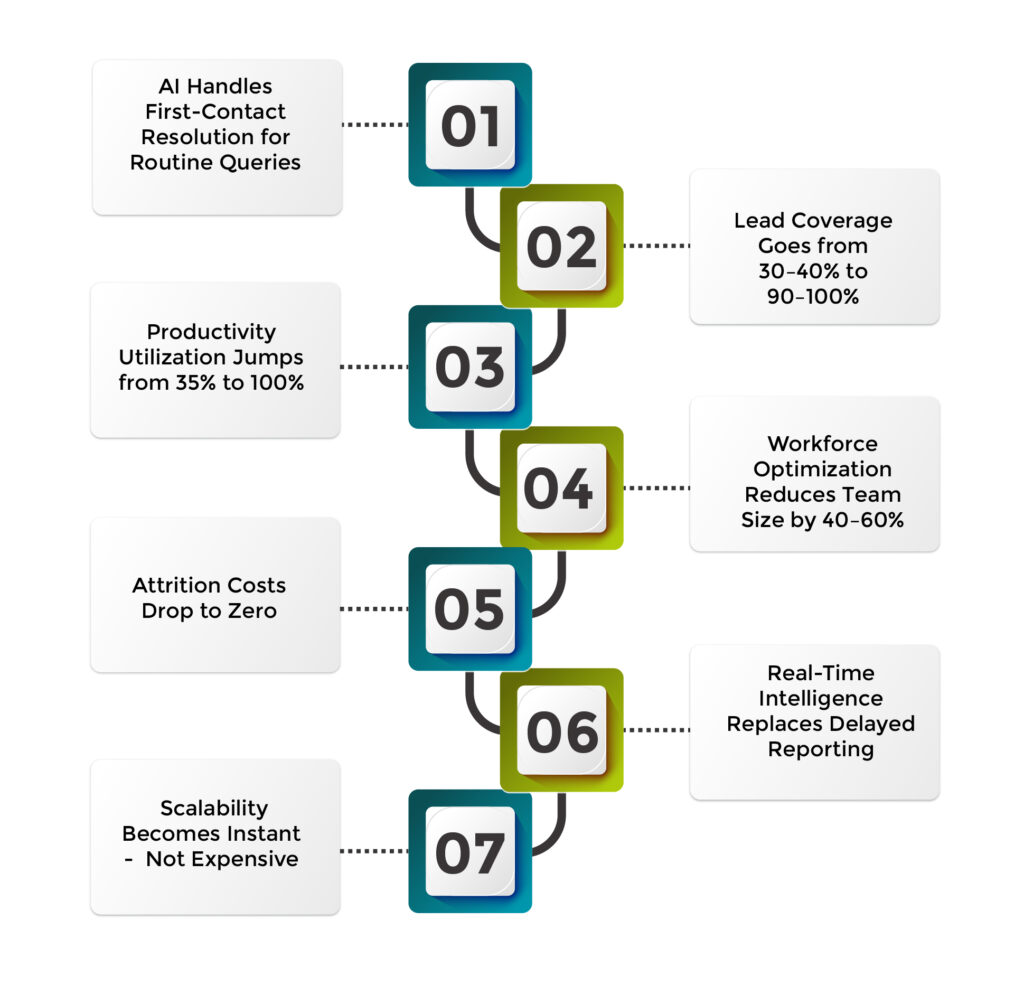
- 7 Ways Businesses Reduce BPO Costs with AI + Human Models
- The ROI to Management: What the Numbers Look Like at the Top Line
- BPO Valuation: What Determines the Value of a BPO Engagement?
- BPO Cost Analysis: The Total Cost of Ownership Framework
- Nearshore vs. Offshore vs. Onshore: A Cost Comparison
- What to Look for in a BPO Partner
- Conclusion
- FAQs
Key Takeaways
- Models of combining AI and human BPO are capable of reducing operating costs by 30-50%, whereas productivity also gets better.
- AI takes over monotonous tasks, freeing up human agents to spend their time on more sophisticated customer interactions.
- With AI-powered workflows, businesses can raise the percentage of lead coverage from 30-40% to 90-100%.
- Keeping attrition rates low, reducing costs of training and infrastructure, and at the same time enhancing the scalability feature are a few things that hybrid models can do.
- Using real-time analytics and automating processes allows people to make decisions quickly and deliver better customer experiences.
- The best BPO plans incorporate a great mix of AI’s effectiveness and human skills to ensure the highest return on investment and business growth.
When a business starts evaluating outsourcing, BPO cost is the first thing on everyone’s mind – not culture fit, not time zones, not technology stacks. Let’s be direct. When a business starts evaluating outsourcing, the first question is rarely about culture fit or time zones.
It is always: How much is this going to cost me?
That is a fair question. BPO cost is one of the biggest factors driving outsourcing decisions today. And with AI now reshaping the industry from the ground up, the math has changed significantly – in ways that are proving better than most businesses expected.
Companies that once paid for full human support teams are now discovering a smarter way to operate. They are blending AI automation with skilled human agents. The result? Operating costs come down. Output goes up. Quality becomes consistent. And the business scales without hiring linearly.
This article breaks down exactly how that works – and what it means for your bottom line.
You will learn what BPO means, how BPO pricing is structured, and why the AI + human hybrid model is quickly becoming the gold standard for cost-effective BPO services worldwide.
What Is a BPO?
Before diving into costs, let us set the foundation.
BPO stands for Business Process Outsourcing. It means appointing an external firm for outsourcing particular business functions- customer support, data entry, back office activities, help desk, finance,e HR, or telemarketing.
Originally, BPO was simple: hire people in lower-cost regions, hand off your tasks, save money.
Today, BPO is far more sophisticated. Businesses are not just outsourcing work. They are commissioning complete intelligent workflows- enabled by AI applications, analytics infrastructure, and a team of expert human specialists.
The Three Main Types of BPO
BPO Type | What It Covers | Example |
Back-Office BPO | Internal operations | Payroll, HR, data processing |
Front-Office BPO | Customer-facing tasks | Support, sales, live chat |
Knowledge Process Outsourcing (KPO) | Specialized expertise | Legal research, financial analysis |
Knowing what type is required for you is the first step towards an accurate BPO cost analysis.
What Does BPO Cost in 2026?
A one-price model for BPO does not exist. Pricing depends on region, type of service, volume, technology stack,k, and contract structure.
BPO Pricing Models at a Glance
- Per-Hour Pricing: The most common model for customer support and back-office work. Rates vary by region:
- United States / Canada (Onshore): $25–$65 per hour
- Europe: $20–$45 per hour
- Latin America (Nearshore): $10–$22 per hour
- Philippines / India (Offshore): $6–$14 per hour
- Per-Transaction Pricing: Generally used for high volume and repetitive work. The price tag range is from $0. 10 to $5. 00 per transaction, given the complexity of the job.
- Per-Seat / FTE Pricing: A fixed (per month) per agent cost. Can be as low as $800 and go as high as $3,500 (per FTE) per month based on skill-set and location. In the case of the Indian BPO industry, this cost is estimated at Rs. 15,000 to Rs. 20,000 per agent per month for frontline roles.
- Outcome-Based Pricing: Results-driven companies’ payments for resolved tickets, converted leads, and processed claims are growing exponentially.
This model has gained popularity so quickly because it aligns vendor incentives with company goals.
- AI + Human Hybrid Pricing: This is the model changing everything. AI takes some of the load away at a fraction of the human agent price. Humans step in for complex cases only. Billing is based on connected, productive interactions – not idle seat time. This is where the biggest BPO cost savings are being realized today.
The Human Model vs. The AI + Hybrid Model: A Direct Comparison
Below is information sourced from an active ROI analysis (May 2026) where human-agent BPO (business process outsourcing) operations are being compared to AI + hybrid implementations within the Customer Facing and Sales processes.
Monthly Cost Structure
Parameter | Human Agent Model | AI + Hybrid Model | Business Impact |
Monthly Cost | ₹15K–₹20K per agent (fixed salary) | Variable – pay per connected interaction | Pay for output, not idle time |
Productivity Utilization | 30–35% (low connect rate) | 90–100% (only connected calls billed) | 3x–4x efficiency gain |
Equivalent Output | 3–4 agents required | 1 AI agent equivalent | Direct manpower reduction |
Total Cost for Same Output | ₹60K–₹80K | ~₹70K | Cost-neutral – with significantly higher output |
Let that sink in. You get the same output, nearly the same cost – but with a dramatically leaner team, higher quality, and zero attrition risk.
And that is just the baseline. As soon as AI begins to boost conversions, the odds are comfortably stacked in favor of the hybrid.
Operational Performance Comparison
Parameter | Human Model | AI + Hybrid Model |
Sales Conversion Rate | Lower (delays, missed follow-ups) | Higher (instant + consistent follow-ups) |
Average Handle Time (AHT) | Higher (manual effort, pauses) | Reduced (AI pre-qualifies + assists) |
Customer Satisfaction (CSAT) | Inconsistent (agent dependent) | High and consistent |
Lead Coverage | 30-40% | 90-100% |
Follow-up Efficiency | Manual, often missed | Automated and timely |
Working Hours | 8-9 hours/day | 24×7 |
The difference in lead coverage alone is striking. Human-only models reach 30–40% of leads. The AI + hybrid model reaches 90–100%. That gap represents real missed revenue – every single day.
Infrastructure, Scalability, and Intelligence
Parameter | Human Model | AI + Hybrid Model |
Training Dependency | High (continuous training required) | Minimal (AI trained once, improves over time) |
Attrition Impact | High in the ₹15–20K salary band | Zero |
HR Costs | Recruitment, onboarding, payroll management | Negligible |
Seat / Infrastructure Cost | Per agent (system, space, telecom) | Minimal incremental cost |
Scalability | Slow (hire and train) | Instant |
Consistency and Quality | Variable | 100% consistent |
Call Insights | Limited/manual | Full transcription + sentiment + intent analysis |
Decision Making | Delayed reports | Real-time dashboards |
Attrition alone is a hidden cost that businesses frequently underestimate. In the ₹15,000–₹20,000 per month salary band, annual turnover in traditional BPO operations is very high. Every departure means recruitment costs, onboarding time, and a dip in service quality. The AI + hybrid model eliminates this for AI-managed workflows.
7 Ways Businesses Reduce BPO Costs with AI + Human Models
Here are the seven highest-impact strategies businesses are using right now.
1. AI Handles First-Contact Resolution for Routine Queries
Most incoming support requests are trivial if not repetitive requests (for password resets, order status, or common questions about the account. AI-based chatbots and intelligent virtual agents (IVA) solve all these things within seconds with little/no human support.
Human agents are freed for higher-value interactions. Cost per resolution drops. Volume handled per agent goes up.
The more routine queries AI absorbs, the lower the overall cost per interaction – and the faster the ROI on the hybrid model.
2. Lead Coverage Goes from 30–40% to 90–100%
In most human-agent concepts, there is a contact rate of only 30-40% of the leads (limited by hour, the lack of dialer automation, follow-up gaps, and idle time).
The AI + hybrid model can do 90-100% of the leads as it runs 24×7 at a standard follow-up frequency.
For any business running outbound sales or lead qualification through a BPO, this difference in coverage directly translates to increased revenue – at no proportional increase in cost.
3. Productivity Utilization Jumps from 35% to 100%
When you pay for a human agent at ₹15,000–₹20,000 per month, you are paying for the full working day – including idle time, unanswered calls, unavailable contacts, and low-productivity periods.
In practice, actual productive utilization sits at 30–35% of paid hours.
The AI + hybrid model flips this entirely. You are billed only for connected, productive interactions. Utilization runs at 90–100%. The 3x–4x efficiency gain this creates is not a projection – it is a structural outcome of how the billing model works.
4. Workforce Optimization Reduces Team Size by 40–60%
Real-world workforce data from AI + hybrid deployments shows a consistent pattern:
| Scenario | Traditional Model | AI + Hybrid Model | Impact |
| Team Size Required | 100 Agents | 40–60 Agents + AI | 40–60% manpower reduction |
| Cost Structure | High fixed cost | Optimized variable cost | Better cost control |
| Productivity | Low (idle + manual) | High (AI handles repetitive tasks) | Output increases significantly |
| Agent Role | Dialing + basic queries | Focus on hot leads and closures | Higher revenue per agent |
This is not about replacing people. It is about repositioning them. Human agents move from repetitive, low-value tasks to high-value conversations – closures, complex issues, relationship-building. Their contribution per seat goes up. Total headcount requirement goes down.
5. Attrition Costs Drop to Zero
BPO attrition is an ongoing operational headache within the 15000-20000/monthly-pay band. Every time an employee leaves, there is a recruitment and onboarding time, and a quality gap.
Of course, the attrition that exists for the human workforce of course, would simply be transferred to the hybrid workforce, but again in much less volume. With the AI+ hybrid model, there is no attrition in the AI-managed workflows. And for the little remaining human team- now “serving the rarified premium interactions- we simply see much higher retention.
6. Real-Time Intelligence Replaces Delayed Reporting
Traditional BPO operations generate reports. AI + hybrid operations generate intelligence.
Full call transcription, sentiment analysis, and intent detection, together with real-time dashboards, replace the weekly summaries received with a delay. This matters for cost because faster decisions reduce waste. Underperforming campaigns get adjusted in hours, not weeks. Coaching happens based on full-interaction data – not a small manual sample.
7. Scalability Becomes Instant – Not Expensive
Scaling a traditional BPO operation means hiring, training, equipping, and onboarding new agents. That takes weeks to months and carries real cost and operational risk.
Scaling the AI + hybrid model is near-instant. Additional AI capacity deploys in hours. The human component scales modestly, without the overhead of full-cycle recruitment.
For businesses with seasonal demand spikes or fast growth phases, this agility is a direct and measurable cost advantage.
The ROI to Management: What the Numbers Look Like at the Top Line
Senior leadership evaluating BPO cost decisions ultimately cares about business-level impact.
Here is the consolidated ROI picture from AI + hybrid model deployments:
Area | Impact |
Revenue Growth | 3X increase |
Cost Reduction | 30%–50% lower operating cost |
Profitability | 2X–4X improvement in margins |
Efficiency | Same output with 40% fewer resources |
Scalability | Growth without increasing cost linearly |
These are outcomes drawn from actual AI + hybrid BPO implementations – and they represent exactly why this model has moved from an interesting option to mainstream operational strategy.
BPO Valuation: What Determines the Value of a BPO Engagement?
BPO valuation matters when you are pricing a contract or assessing whether a provider’s rates reflect the genuine value being delivered.
Key Factors in BPO Valuation
Labor Arbitrage Value: The gap between the in-house cost and the BPO rate. In the AI + hybrid model, this goes beyond simple geography-based arbitrage – AI multiplies the effective output per rupee or dollar spent.
Technology Stack: Providers run AI-driven workflows, real-time sentiment analysis, and automated QA. They bring quite a bit more value per hour than traditional system users.
Talent Quality and Attrition Rate: High attrition is a hidden cost multiplier. A provider rebuilding a large portion of its workforce every year does so at the client’s expense, with inconsistency, retraining time, and quality gaps. This belongs in every serious BPO cost analysis.
Scalability: A provider that can scale capacity – agents or AI – within weeks is worth a premium over one requiring long lead times. Business growth should not be gated by outsourcing logistics.
Compliance and Data Security: ISO 27001, SOC 2, GDPR, HIPAA – these are not optional in regulated industries. The cost of a compliance failure dwarfs any outsourcing savings many times over.
Reporting Depth and Transparency: Real-time dashboards, full-interaction transcription, sentiment tracking, and SLA visibility indicate a mature operation. Providers who can only offer periodic PDF summaries are working with yesterday’s infrastructure.
BPO Cost Analysis: The Total Cost of Ownership Framework
Most businesses approach BPO pricing by comparing headline per-hour or per-seat rates. That approach consistently underestimates the real picture.
True cost analysis compares Total Cost of Ownership (TCO) – in-house versus outsourced – across all dimensions.
The TCO Comparison Model
Cost Category | In-House | AI + Human BPO |
Labor (salary + benefits) | High | Low to moderate |
Productivity Utilization | 30–35% effective | 90–100% effective |
Recruitment and Onboarding | Significant and recurring | Absorbed by the provider |
Training and Development | Ongoing and costly | Minimal (AI trained once) |
Infrastructure and Technology | High CapEx | Included in contract |
Management Overhead | High percentage of headcount cost | Minimal |
Quality Assurance | Separate cost center | Often included |
Attrition Cost | High and recurring | Zero for AI workflows |
Scalability Cost | High (hiring lead times) | Low (on-demand) |
AI and Automation Investment | Large upfront cost | Shared across clients |
When you map this correctly, the true cost advantage of AI + hybrid BPO becomes very clear. The headline rate per hour is rarely the full story – and often a misleading one.
Nearshore vs. Offshore vs. Onshore: A Cost Comparison
For businesses evaluating BPO geography, here is a practical framework.
Nearshore BPO (Latin America)
Cost range: $10–$22 per hour (agent cost)
Best for: Organizations that have a high demand for collaboration that must happen in real time, be culturally acceptable, and afford a drastic cut in costs at the same time. The Nearshore advantage:
Given a combination of the same or next-door time zones, excellent English skills, and labor expenses that can be as much as 60% less than U.S. alternatives, beyond smooth integration with an AI-enabled solution. Nearshore BPO jobs are attractive to U.S. firms:
Offshore BPO (Philippines / India)
Cost range: $6–$14 per hour (agent cost)
Best for: High-volume, process-intensive businesses, where the main emphasis is on cost reduction. Affordable BPO outsourcing from the Philippines is still perceived to be the standard bearer for offshore English support.
The country has an established BPO sector with abundant talent streams and surging AI penetration into its largest delivery centers.
Onshore BPO (United States / Canada)
Cost range: $25–$65 per hour (agent cost)
Best for: Regulated by strict industries or complex technical support, or government contracts, where compliance and data sovereignty are a necessity.
In reality, the most successful operations employ a hybrid model with AI, offshore/near-shore churn team, and onshore specialists handling tier-,1, and 2 3 cases respectively.
This architecture optimizes cost at every level of the service stack.
What to Look for in a BPO Partner
Choosing the right partner is as important as understanding the pricing. Before signing anything, evaluate these factors:
- Technology-first mindset: Will the provider utilize AI for automation qa analytics, and workforce optimization – or are they still operating on legacy systems?
- Transparent pricing: Is the model transparent?
- Demonstrated domain expertise: Have they worked with clients that have similar compliance environments to your own?
- Scalability: Are they capable of cascading within weeks, not months?
- Real-time reporting: Live dashboards and SLA transparency – not periodic overviews.
- Client references: Current clients who are open and honest about their experience.
- Data security posture: ISO 27001, SOC 2, and GDPR compliance at a minimum.
- Attrition rates: Ask directly. High turnover is a hidden cost you will absorb.
Conclusion
The question is no longer whether AI belongs in BPO operations. That conversation is settled.
The real question is: How do you structure an AI + human BPO model that genuinely reduces costs without compromising quality?
A well-implemented AI + hybrid model delivers measurable outcomes across every key business metric – lower operating costs, higher lead coverage, stronger margins, instant scalability, and real-time intelligence that keeps decision-making sharp.
Whether you are seeking low-cost near-shore BPO options from Latin America, low-cost BPO services from the Philippines, or creating a blended multi-region model, the basics are the same. If you are looking at low-cost nearshoring BPOMexico and low-cost BPOs in the Philippines or creating a blended multi-region model, then the underlying parameters are the same, like this.
Use AI to handle what AI does best. Use skilled humans to handle what humans do best. Measure everything with real-time data. And choose a BPO partner who treats your cost targets as their own.
Do that well, and BPO stops being a cost center. It becomes a genuine competitive advantage.
FAQs
1. How much do you charge for a BPO?
BPO rates for services are dependent on service type, delivery location, skill profile, and nature of the contracts. Onshore, economies of scale on a larger scale can be leveraged by using offshore BPO services such as those available in the Philippines at a price of $6 to 14 per agent per hour. Nearshore BPO solutions in Latin America are priced between $10 and 22 an hour. In the Indian subcontinent market, front-line agent costs fall in the ₹15,000–₹20,000 per month range for human-model operations. AI + hybrid models frequently employ outcomes-based, variable pricing. Instead of a price per seat or hour, they charge by connected interaction. Request a custom BPO cost comparison from suitable vendors based on your specific volume, complexity, and service demands.
2. What is a BPO, and how does it differ from traditional outsourcing?
Business process outsourcing (BPO) is the practice of contracting a third-party provider to handle a lot of business processes like customer services, data entry, back-office processing, human resources, finance,e information technology, or sales reaching. Unlike traditional outsourcing models based first and foremost on relocating headcount to cheaper geographies, contemporary BPOs are usually characterized by the use of artificial intelligence automation, analytics, and intelligence processes. Current BPO providers have often become operational partner businesses, providing demonstrable business results, not simply people capacity.
3. What is BPO valuation, and why does it matter when selecting a provider?
BPO valuation is about researching the actual value of a BPO engagement – financially and operationally. For a buying business, that means judging labor arbitrage value, technology capability, talent quality, scalability,y compliance strength, and reporting depth collectively. A low per-hour rate is worth very little if worker attrition is high, technology is aging, or productive utilization is low. Any rigorous BPO cost analysis should benchmark Total Cost of Ownership over headline rates only.
4. What makes nearshore BPO solutions cost-effective?
Inexpensive nearshore BPO options have combined the cost advantages of cheaper labor with some of the speed benefits that a pure offshore operation may have. For a business based in the U.S., a nearshore provider in Latin America offers U.S. time zones, excellent English skills, cultural affinity, and offshore cost levels, often while remaining fully synchronized in real time. When combined with AI support, productivity per agent improves further, reducing cost per interaction while at the same time increasing quality levels.
5. How do AI + hybrid BPO models perform on customer satisfaction?
AI + hybrid models consistently outperform both purely human and purely automated approaches on customer satisfaction. Human-only models give variable CSAT scores as they are agent-dependent. A fully automated model risks frustrating customers with complex queries. Still, the hybrid model gives consistency over mundane questions, with complex and sensitive cases being escalated to (experienced) agents, delivering high and consistent CSAT scores.
6. How do I run a proper BPO cost analysis for my business?
The first step is to get a picture of your current total cost in-house, including all labor benefits, recruiting, training infrastructure,e software, management overhead, and quality assurance. Follow that by getting detailed bids from BPO vendors on the same scope of work and with complete transparency as to pricing model, technology setup, operational efficiency utilization level, SLA guarantees in place, etc. Weigh the Total Cost of Ownership for all options – not just on a charge per-hour basis. Take also into account efficiency improvements that come from artificial intelligence, the impact of attrition, call lead coverage rate, growing your operation as you would for an enterprise, etc. BPO vendors that operate an AI + hybrid model should be able to show us cost per transaction calculations, productivity utilization rates, and optimization of conversion metrics for similar organizations.






 Reduces response times by 50%
 Date: 19th February, 2025
 Time: 12 PM – 1 PM (EST)
 Where: LinkedIn Live