

Summarize this article with:
- Introduction
- What Are AI Agents in Healthcare, Exactly?
- Why Healthcare Is a Perfect Fit for AI Agents
- The 8 Most Impactful Use Cases for AI Agents in Healthcare
- Agentic AI vs. Traditional Healthcare AI: What Is the Difference?
- What Healthcare Leaders Are Saying
- The Marketing Opportunity: Why Healthcare AI Is a Brand Differentiator
- 5 Things to Get Right Before Deploying Healthcare AI Agents
- The Regulatory Landscape: What You Need to Know
- A Glance at Leading Healthcare AI Agent Platforms
- The Human Element: AI Agents Are Not Replacing Physicians
- What the Next 3 Years Look Like
- Conclusion
- FAQs
Key Takeaways
- AI agents are also able to handle and automate other healthcare workflows like scheduling billing documentation, and patient communication.
- They help reduce the administrative burden, which allows clinicians to have more time for patient care.
- Healthcare organizations that deploy AI agents are able to achieve greater efficiency, accuracy, and higher operational ROI.
- AI agents are being used to triage patients, assist with medication and monitor chronic diseases.
- Agentic AI is more capable than simple chatbots in that it can perform actions, integrate systems, and handle end-to-end workflows.
- In order for healthcare providers to be successful in adoption, they should focus on EHR integration governance compliance and training of staff.
- AI agents improve the patient experience by providing personalized, proactive, and round-the-clock support.
- The healthcare of tomorrow will be a synergy of human experts and AI-driven digital workforces to achieve better results.
Today’s AI agents in healthcare are no longer just a whiteboard idea; they are a deployed, functioning way to change the way care is delivered, managed, and experienced. They set appointments, interpret labs and imaging, identify drug-drug interactions, support diagnostic decisions, and track the pharmaceutical supply chain. Healthcare is experiencing some of the most profound digital changes in its history, and AI agents are at the heart of it.
Picture this. A patient calls a hospital at 2 a.m. with a billing question. But, rather than receiving the call the next day, an AI agent takes the call, solves the problem, updates the record, and records the interaction without waking a single employee.
Sound futuristic? It is already happening.
According to a 2024 report by McKinsey & Company, generative AI in healthcare could unlock between $1 trillion and $1.4 trillion in value across the U.S. health system alone. A separate study by Grand View Research projects the global healthcare AI market will reach $208.2 billion by 2030, growing at a CAGR of 38.5%.
The numbers are staggering. But the real story is not in the numbers. It is in what these agents actually do – and why forward-thinking healthcare leaders are moving fast to adopt them.
This article breaks it all down: what AI agents are, how they work in healthcare, where they deliver the most value, and what your organization needs to know before deploying them.
What Are AI Agents in Healthcare, Exactly?
Before we get into too much detail, let us just clarify some definitions.
An AI agent can be defined as a software agent that can observe its environment, reason, take actions, and learn, without the explicit approval of a human at each step.
It’s like the difference between a simple dialog bot ( answering questions based on a script) and an AI agent (that knows the context, integrates with many other systems, takes autonomous actions, and self-learning).
In healthcare, this distinction is enormous.
A basic chatbot tells a patient: “Your appointment is at 3 p.m.”
An AI agent notices the patient has not confirmed, checks their calendar via integration, sends a reminder, reschedules if needed, updates the EHR (Electronic Health Record), and alerts the care team – all automatically.
That is agentic AI in healthcare: proactive, context-aware, and action-oriented.
Why Healthcare Is a Perfect Fit for AI Agents
Medical practice has been data-rich yet resource-poor.
Physicians spend as much as 34% of their time doing paperwork (Definitive Healthcare survey, 2023).
Nurses spend almost a quarter of their shift documenting instead of caring. This is precisely where AI agents directly address this inefficiency:
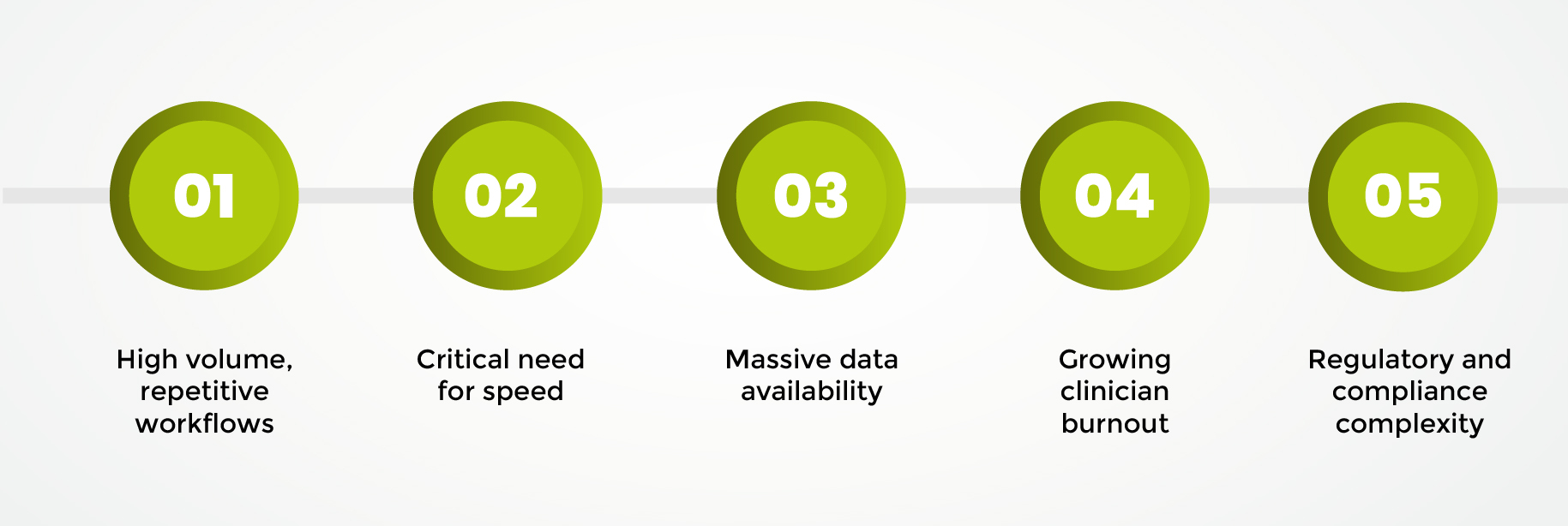
- High volume, repetitive workflows – Prior authorizations, billing, scheduling, and documentation are rule-based and very automatable.
- Critical need for speed – In critical and diagnostic scenarios, AI decisions with higher speed may possess life-saving potential.
- Massive data availability – EHRs, imaging data, lab data, and genomic data provide agents with strong sources to get inputs from.
- Growing clinician burnout – Removing administrative burden from healthcare workers has a direct human impact.
- Regulatory and compliance complexity – AI agents can keep an audit trail and alert you to compliance risks in real-time.
The result? Healthcare AI solutions are now moving from pilot programs into full-scale, enterprise-wide deployment.
The 8 Most Impactful Use Cases for AI Agents in Healthcare
Let us be specific. Here’s where healthcare AI agents are actually making meaningful, measurable impacts today.
1. Clinical Documentation and Charting Automation
Physicians devote a lot of every day to EHR documentation. An AI agent with Voice Recognition and NLP could take dictation, organize, and electronically file clinical notes during patient visits.
Real-world use case: Nuance DAX (Dragon Ambient eXperience), now a part of Microsoft Azure, transcribes clinical notes from conversations between the providers and the patients.
Initial publications celebrating this innovation showed a 50% drop in time required to write notes as well as increased physician satisfaction. AI agents don’t just transcribe: They also compile notes into structured documents, identify where information is missing, and send completed records down the correct workflows.
2. Intelligent Appointment Scheduling and Patient Access
Missed visits result in $150 billion in added cost to physicians and other health care providers per year in the United States in 2022, based on a study in the Annals of Family Medicine. AI agents drastically cut that total. How? They:
- Send reminders personalized by desired mode (SMS/email/in application)
- Predict no-show risk and actively offer backfill scheduling
- Manage rescheduling independently
- Coordinate for multi-specialty visits involving multiple departments
- Patients have a more seamless experience.
Providers make more appointments.
Everyone wins.
3. Prior Authorization and Revenue Cycle Management
Prior authorization – the process of getting insurer approval before certain treatments – is notoriously time-consuming. It consumes an average of 12 staff hours per physician per week, based on AMA (American Medical Association) data.
Agentic AI healthcare solutions can:
- Retrieve appropriate clinical documentation automatically
- Category match treatment codes to payer guidelines
- Request authorization
- Follow up on approvals waiting on
- Flag the denials and appeals.
Organizations have reported authorization cycle time going from days to hours after implementing AI agent revenue cycle workflows.
4. Drug Interaction and Medication Management
Medication errors remain a continuing and preventable threat to patient safety. The WHO estimates that medication errors result in a minimum of 1 death per day and injury to 1.3 million people in the US per year.
AI agents integrated into EHRs and pharmacy systems work in real time, constantly monitoring prescriptions. In the background, they identify potential drug-drug interactions, cross-reference allergy history, verify appropriate dosing for patient weight and renal function,n and notify clinicians instantly.
Compared to static alerts, which are easily disregarded due to ‘alert fatigue’, better AI agents are aware of the risk – differentiating between low-priority flags and truly hazardous interactions – which greatly enhances response rate.
5. Diagnostic Support and Clinical Decision Intelligence
This is about where it starts getting really cool. AI agents in healthcare can help clinicians discover patterns that may be difficult for the human eye to see by training on medical imaging, genomic information, and clinical records.
Key Examples:
- Radiology AI Platforms like Aidoc and Viz.ai read CT scans and MRIs in real time to flag detection of life-threatening findings for fast referral to a physician.
- For example, detecting a pulmonary embolism or bleeding intracranially. Pathology AI: An AI agent helps to analyze biopsy slides. This way is able to speed up and standardize the diagnosis.
- Predictive risk scoring: In ICUs, AI agents (so from the AI system backing EarlySense) monitor total patients’ vitals and predict clinical deterioration up to 6 hours ahead.
In a groundbreaking 2023 research published in Nature Medicine, where AI agents beat radiologists in fighting early breast cancer detection from mammograms in a nationwide UK trial by 2.
6. Patient Engagement and Chronic Disease Management
Managing a chronic condition is exhausting for patients – and often invisible to care teams between appointments.
AI agents serve as continuous digital health companions. They:
- Send medication reminders
- Monitor the self-reported symptoms data
- Known health variables show abnormal signals
- Provide Customized Education Content
- Know when and how to escalate to a care co-ordinator
For certain diseases, namely diabetes, heart failure, and COPD, AI-based patient engagement has also demonstrated achievement in results.
7. Supply Chain and Inventory Optimization
It is an immensely complex area in a hospital. Stock-outs of important supplies, overstocking of items with a short shelf life, and pen and paper inventory procedures may all contribute.
AI agents in healthcare monitor consumption trends, forecast requirements based on patient census and operating room schedules, generate purchase orders automatically, and track products close to their expiration date.
During COVID-19, AECS-enabled hospitals were far better equipped to get through the PPE shortages and ventilator-limited supply challenges. This agentic AI application has quietly emerged as one of the highest roi healthcare operations use cases.
8. Cybersecurity and Compliance Monitoring
Healthcare is the most attacked industry for cybercrime. AI Agents are an ongoing monitoring system that monitors network traffic, detects unusual access patterns, applies data governance rules, nd instantly alerts you if anything looks like a potential HIPAA breach.
Unlike anti-virus and other traditional security tools, whose detections are based on previously known signatures, AI agents employing machine learning can identify new attack types,s which is a growing necessity due to mature ransomware and phishing attacks.
Agentic AI vs. Traditional Healthcare AI: What Is the Difference?
This distinction matters a lot, especially for technology decision-makers.
Feature | Traditional AI Tools | Agentic AI Healthcare |
Interaction style | Reactive (responds when triggered) | Proactive (acts autonomously) |
Task scope | Single-task, narrow | Multi-step, cross-system |
Decision-making | Human approves each step | Executes with defined autonomy |
Learning | Static models | Continuous improvement |
Integration | Often siloed | Connects multiple systems |
Example | Diagnostic algorithm | End-to-end patient journey agent |
Traditional AI tools in healthcare are useful. But they are fundamentally passive. They wait to be asked, they answer one question, and they stop.
Agentic AI healthcare solutions act. They initiate workflows, connect disparate systems, make sequential decisions, and close the loop – without requiring a human to supervise every click.
This is the leap from a calculator to a co-pilot.
What Healthcare Leaders Are Saying
The executive community is paying close attention.
Dr. Eric Topol, founder of the Scripps Research Translational Institute and one of the foremost voices in digital health, has noted that AI agents represent “a profound opportunity to restore the human side of medicine by eliminating the administrative burden that has eroded the physician-patient relationship.”
The sentiment is echoed across C-suites. A survey of healthcare executives conducted by Deloitte in 2024 stated that 73% of respondents intended to boost spending on AI automation in the upcoming 2 years. More telling: 61% identified agentic AI as the category they expect to drive the most operational impact.
The direction is clear. Healthcare AI solutions are not an experiment anymore. They are a strategic imperative.
The Marketing Opportunity: Why Healthcare AI Is a Brand Differentiator
Let us speak directly to the marketing professionals in the room.
AI agents in healthcare are more than tools for operation. They are signals for brands.
Patients are choosing providers more based on digital experience. Per a 2023 Accenture survey, 60% of patients indicated they would seek out a different provider if they found digital access better–quicker scheduling, proactive communication, tailored follow-up.
AI agents deliver all of this, and this can be a defining UK competitive advantage, if it is packaged and sold correctly. Key marketing angles to consider:
Key marketing angles to consider:
- Speed as a value proposition: “Receive treatment even more quickly with scheduling and triage driven by Artificial Intelligence. “
- Personalization at scale: “Your care, customized to your health history and preferences. “
- Accessibility and availability: “AII health assistant, trained to help you, at any hour, any day, 24×7.”
- Transparency and trust: “AI’s that aid your doctor’s decisions, never substitute them. “
Healthcare organizations that are planning to pour resources into agentic AI ought to be promoting that fact to their customer base. If done properly, it is helpful in gaining trust, relieving fears about technology among patients, and reinforcing the brand as innovative and personable.
5 Things to Get Right Before Deploying Healthcare AI Agents
Ready to move? Great. Here are the five non-negotiables for a successful deployment.
1. Start With a Clear Use Case, Not a Technology Hunt
The most ineffective way to adopt AI is to purchase a platform and then try to identify use cases. Begin by identifying a one high-value workflow with defined results and pain points.
Prior authorization is often the best entry point. It is painful, well-defined, and the ROI is immediate.
2. Ensure EHR Integration Is a Day One Priority
An AI agent that cannot have direct access to your EHR, billing, and scheduling system really limits their capabilities. Standardization and Interoperability should not be optional.
Ask vendors more granular questions on whether those products adhere to the HL7 FHIR standard, API availability, and how protects data during integration.
3. Build a Human-in-the-Loop Governance Model
Okay, but even the best AI agent will go wrong. Establish clear escalation protocols: what does the AI do autonomously, what action must be verified by a human operator before being enacted, and what should always be escalated to a clinician?
Document this clearly. Regulators and accreditation bodies will ask.
4. Train Your Staff, Not Just Your Models
The biggest implementation risk is not technical. It is cultural. Clinicians and administrators who do not get AI agents or trust them will go around them–defeating the purpose. Invest in training.
Present AI agents as staff-saving tools, not job-automating threats.
5. Measure, Iterate, and Report
Metrics at baseline before go-lives on End Point: 30/day goal, average time on task, 50% avg error rate, 30% staff satisfaction, 35 pt NPS. Monitor metrics at 30, 60, and 90 days post go-live. Determine baseline metrics pre-go-live, like time to complete tasks, number of errors made, staff satisfaction, and patient NPS. Track 30, 60, 90 days after go-live.
Share results internally.
Continuous improvement is not a feature – it is the whole point of deploying an adaptive AI system.
The Regulatory Landscape: What You Need to Know
Healthcare is very heavily regulated, and AI agents are no exception.
Key considerations include:
- FDA oversight: Based on its intended use, the AI/ML-based SaMD may need FDA clearance, mainly if it is used for diagnostic purposes.
- HIPAA compliance: All AI agents processing PHI need to adhere to the HIPAA Privacy and Security Rules. Data storage processing agreement, and vendor BAAs need to be completed.
- CMS guidelines: CMS has imposed additional transparency requirements for billing and prior authorization agents for recommendations produced by AIs.
- EU AI Act (for global organizations): The EU AI Act categorizes AI systems used in healthcare as ‘high-risk’, meaning they must have comprehensive documentation, human oversight, and conformity assessments.
None of this is a reason to slow down. It is a reason to involve your compliance and legal teams from day one.
A Glance at Leading Healthcare AI Agent Platforms
The market is maturing rapidly. Here is a snapshot of notable healthcare AI solution providers:
Platform | Primary Focus | Notable Feature |
Nuance DAX (Microsoft) | Clinical documentation | Real-time ambient AI charting |
Aidoc | Radiology AI | Critical findings triage |
Viz.ai | Stroke and cardiovascular AI | Automated care coordination |
Notable Health | Patient access automation | End-to-end scheduling and intake |
Olive AI | Revenue cycle automation | Cross-system workflow agents |
Health Language (Wolters Kluwer) | Compliance and coding | NLP-driven coding accuracy |
Hippocratic AI | Patient communication agents | Safety-focused conversational agents |
This is not an exhaustive list – the field is growing fast. But it illustrates the breadth of healthcare AI solutions now available across clinical, operational, and administrative domains.
The Human Element: AI Agents Are Not Replacing Physicians
Let us address the concern that is probably sitting in the back of your mind (or your colleagues’ minds).
No – AI agents are not replacing doctors.
They are replacing paperwork.
The most compelling vision of agentic AI in healthcare is not one where machines make diagnoses alone. It is one where every physician, nurse, and care coordinator spends the vast majority of their time doing what only humans can do: listen, empathize, decide, comfort, and connect.
AI agents handle the administrative load. The documentation. The scheduling. The reminders. The data retrieval. The billing follow-ups.
When those tasks are handled – reliably, quickly, and accurately – the human members of the care team get to be fully present with patients.
That is a powerful story. And it is one that healthcare marketers, executives, and technology leaders should be telling loudly and confidently.
What the Next 3 Years Look Like
The trajectory for AI agents in healthcare is steep and fast.
Here is what leading analysts and researchers project through 2027:
- Combining different modalities, such as text, image, voice, sensor data, etc., will increase the diagnostic and monitoring capacities. Autonomous prior authorization will be the new industry standard in most cases; AI agents will be handling entire payer interactions with no human involvement.
- Proactive population health agents will contact at-risk patients before the onset of symptoms – a shift from demand-response to request-preemption.
- AI-generated care plans ( co-created by clinicians and agents using patient history, genomics, and outcome data) will become commonplace in precision medicine.
There will be collaboration between agents when different kinds of AIs (imaging documentation scheduling) can talk to each other and support patients through their journey without any disruption.
Conclusion
AI agents in healthcare are not a trend. They are a structural shift in how healthcare organizations operate, compete, and deliver care.
The business case is compelling: reduced administrative costs, faster workflows, fewer errors, better patient experiences, and a care team finally freed from the grind of paperwork.
The marketing is just as compelling, too: AI-enabled healthcare indicates a trailblazing, inclusive, and authentic leap forward for patients.
But the most important case is the human one.
When AI agents handle the work that should never have fallen to physicians in the first place – when nurses spend their shifts caring instead of charting, and when patients get responses at 2 a.m. without anyone losing sleep – that is when the real value of this technology becomes clear.
The digital workforce is here. It is not the future anymore.
The only question is how fast your organization is willing to move.
FAQs
Q1: What is an AI agent in healthcare, and how is it different from a regular healthcare chatbot?
A healthcare chatbot is a reactive and keyword-driven agent. This means that a chatbot is designed to respond to certain questions and navigate users down predetermined routes. An AI agent can be multi-step and autonomous, spanning numerous systems in one go: schedule an appointment, enter notes in an electronic health record, reengage with the patient after their visit, submit a billing request, and orchestrate a longitudinal care experience.
Q2: Is agentic AI in healthcare safe for patient use?
The strongest factors for the safe implementation of agentic AI, healthcare design governance, and oversight. Healthcare AI that is human-in-the-loop controls of clinical decision making, with fail-safes, audit trails, and escalation pathways, is a beginning. The FDA and others have established a standard for AI/ML-Based Software as a Medical Device. A good starting point is FDA-cleared HIPAA-compliant platforms overseen by good governance institutions.
Q3: How do AI agents in healthcare handle patient data privacy?
A responsible healthcare AI agent will handle patient data following the dictates and regulations of HIPAA and similar state privacy laws. Data will be encrypted for transfer, de-identified when prudent, include vendor BAAs, and be subject to access restrictions. Healthcare institutions should ensure any AI vendor has been through third-party security reviews and has up-to-date HIPAA compliance records before payment.
Q4: What types of healthcare organizations benefit most from AI agents?
AI agents find a home across the entire healthcare ecosystem – from major health systems and academic medical centers, to solo practices, specialty clinics, and even health insurance companies. Those organizations with high overhead, complicated billing systems, large volumes of patients, or dense documentation mandates generally will see the largest and quickest ROI. Smaller practices will see value from healthcare AI platforms built to size.
Q5: How long does it typically take to implement AI agents in a healthcare organization?
Deployment timeframes are use-case and system-deployment-dependent. Deployment for narrow, single-use case applications, e.g, AI-enabled scheduling or prior authorization, can be up and running within 4-8 weeks; Launch for a broader enterprise-wide agentic AI-enabled healthcare model, including EHR integration, interdepartmental workflows, and staff training, can take 3-9 months but be scaled up from a series of smaller trials. Starting with a narrow pilot application will accelerate launch to market.
Q6: Will AI agents replace healthcare workers?
No. Healthcare AI agents are designed to do administration, repetition, and data-related work – not the relational, clinical, and caring experiences that make up the best patient interactions. They are meant to free up clinicians and support staff, not do away with them. The most efficient providers of healthcare understand and embrace the opportunity to have AI agents act as a digital workforce that extends the clinician.






 Reduces response times by 50%
 Date: 19th February, 2025
 Time: 12 PM – 1 PM (EST)
 Where: LinkedIn Live