

Summarize this article with:
- Introduction
- What Is AI Customer Experience?
- Why Customer Experience Matters More Than Ever
- How AI Transforms Customer Experience Management
- 7 Ways AI Customer Experience Solutions Deliver Real Results
- The Human Element: AI and Empathy Are Not Opposites
- Choosing the Right AI Customer Experience Solutions
- What Is Holding Businesses Back - and Why That Is Changing
- Real-World Impact: Industries Leading with AI Customer Experience
- How Vsynergize AI Can Help You Deliver Exceptional AI Customer Experience
- What Vsynergize AI Brings to the Table
- Why Businesses Choose Vsynergize AI
- Conclusion
- FAQs
Key Takeaways
- AI customer experience enables faster, smarter, and more personalized customer interactions.
- Customer experience is now a key competitive advantage that drives loyalty, retention, and revenue growth.
- AI tools like chatbots, virtual agents, and contact center solutions improve efficiency while reducing response times.
- Real-time personalization, predictive support, and omnichannel engagement help businesses meet rising customer expectations.
- AI automates routine tasks, allowing human agents to focus on complex and high-value conversations.
- Success can be measured through metrics such as CSAT, NPS, FCR, AHT, and customer churn.
- Businesses that combine AI efficiency with human empathy can deliver superior customer experiences at scale.
- AI customer experience solutions are now accessible to organizations of all sizes, making adoption easier than ever.
Think about the last time you called a customer support line and waited on hold for 20 minutes. That is a failing of AI customer experience – and it is entirely avoidable. Frustrating, right?
Now think about the last time a brand solved your issue before you even had to ask. That felt different. That felt good.
That is the gap AI customer experience is closing – fast.
Customers today do not just want good products. They want fast, personal, and seamless experiences every single time they interact with a brand. And businesses that deliver that? They win. Businesses that do not? They quietly lose customers to the ones that do.
This article walks you through why AI customer experience is no longer optional, how it works, what it looks like in practice, and why now is the right time to embrace it – no matter the size of your business.
What Is AI Customer Experience?
AI customer experience is a way to apply artificial intelligence tools and services to enhance, customize, and simplify a customer’s every touchpoint with a brand, before, during, and after a sale. It covers different tools and strategies:
Uses of intelligent agents
- Chatbots and virtual agents in artificial intelligence
- Predictive analytics using focus groups and market research to forecast customer needs
- Pipeline for real-time tracking of the customer emotion.
- AI contact center solutions to route and resolve faster
- Recommendations and personalization engines that offer suggestions based on a user’s browsing history and preferences.
AI in customer experience is fundamentally about making each touchpoint more intelligent, efficient, and personable, even when the human being on the other side of the account isn’t there.
Why Customer Experience Matters More Than Ever
Honestly, nowadays, price and product quality won’t hold their loyalty anymore.
According to PwC, 73% of consumers say customer experience is a key factor in their purchasing decisions – yet only 49% say companies actually deliver a good one. That gap is massive. And it is an opportunity.
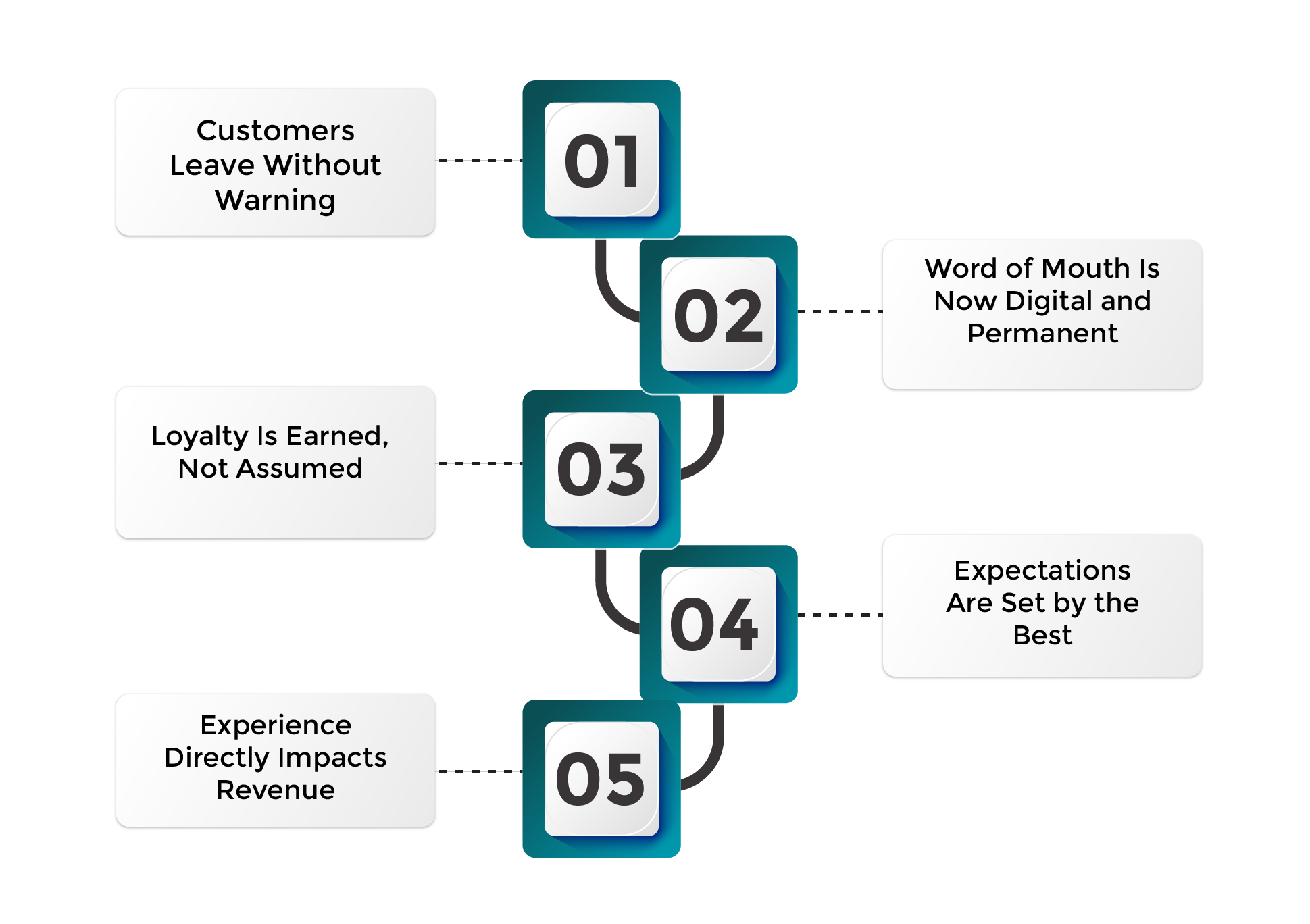
Here are five reasons why customer experience management is now a business-critical function:
1. Customers Leave Without Warning
A customer who has a bad experience rarely sends a complaint email. They simply leave. Research from Esteban Kolsky found that 91% of unhappy customers who are non-complainers just churn. They do not give businesses a second chance. AI helps businesses detect dissatisfaction early – before it becomes a lost customer.
2. Word of Mouth Is Now Digital and Permanent
A single bad review on Google or Trustpilot can result in dozens of potential future customers for a business. A great experience, on the other hand, drives referrals.
3. Loyalty Is Earned, Not Assumed
Bye-bye to loyalty. Subscription models, one-click switching, and a million options mean loyalty has to be earned at every minute of interaction. We won’t track loyalty by default anymore: It’s to be earned. AI customer support platforms make consistent, high-quality service scalable.
4. Expectations Are Set by the Best
Your customers are not comparing you only to your competitors. They compare you to the best experience they have ever had – whether that is with Amazon, Netflix, or their bank’s mobile app. This equalizes the playing field, as the smaller businesses can provide the same enterprise-grade experience.
Zendesk recently published a customer experience research revealing that customers are more and more expecting immediate solutions, personalized interactions, and support without any inconvenience across different channels, which makes AI-powered customer experience a competitive necessity rather than a choice.
5. Experience Directly Impacts Revenue
Bain & Company research shows that companies that lead in customer experience grow revenue 4-8% above their market. This is not a soft metric. This is the bottom-line impact.
How AI Transforms Customer Experience Management
Customer experience management (CXM) is the practice of designing and responding to customer interactions to meet or exceed expectations. AI supercharges every dimension of it.
Here is how:
Real-Time Personalization
AI makes sense of customer information (purchase history, browsing pattern, location device, time of day) and instantly offers tailored content, suggestions,s and offers. AI relies on information about the customer, including past buying habits, browsing habits, current location, device being used, time of day, ay etc. Netflix saves an estimated $1 billion per year in customer retention through AI-driven personalization. That is not a side benefit – that is strategy.
Predictive Support
Rather than doing a reactive response to customer problems, AI can be trained to take a proactive response by anticipating a customer request for assistance. A SaaS operator could say identify a customer hasn’t logged for two weeks, – churn signal – create a trigger, and nudge-champion the customer with a welcome-back email(/chat/help line).
Faster Issue Resolution
AI contact center solutions dramatically lower Average Handle Time (AHT). AI helps human agents while they’re on the calls, suggesting next best actions, providing relevant knowledge base articles, and providing rich customer context so agents spend less time searching and more time solving. McKinsey estimates AI-powered agents will handle issues up to 40% faster.
Sentiment Analysis and Emotion Detection
Modern AI in customer service applications has the ability to interpret the sentiment of a customer’s language when someone is distressed, bewildered, or elated. Businesses can then instantly route interactions with heightened emotions to human agents, minimizing churn at the most sensitive time.
Omnichannel Consistency
Customers transition seamlessly between channels, email, chat, phone, social media, and in-application – and they want you to be there for them. Adaptive Intelligence builds a single profile of each customer and guarantees a connected experience.
7 Ways AI Customer Experience Solutions Deliver Real Results
Now, let’s be specific. These 7 tangible examples of AI customer experience solutions are actually transforming how a business interacts with its customers.
1. AI Chatbots That Actually Help
Early chatbots were frustrating. They followed rigid scripts, misunderstood questions, and constantly transferred users to human agents anyway. Modern AI chatbots powered by large language models (LLMs) are a different story entirely.
They understand natural language. They remember context within a conversation. They draw from live databases, and that’s why they use the latest data to provide the most accurate answer they can. And they are available at all hours – no shift work, no sick days, no nasty moods.
Brands leveraging leading-edge AI customer service platforms claim that up to 80% of some repetitive questions are managed completely by AI. As a result, human agents are freed for richer, more complex conversations.
2. Smarter AI Contact Center Solutions
A contact center is the lifeblood of customer service for most companies, and AI contact center solutions are changing a cost center into a differentiator.
Key capabilities include:
- Intelligent call routing: When the customer starts speaking, the AI gets the purpose and directs the call to the right agent/department, providing the consumer with an immediate, continuous experience.
- Real-time agent assist: AI ‘listens’ to a live call and then pops up relevant information, scripts, and recommendations for the agent.
- Post-call summaries: Automatically generated call notes by AI and may be reduced by as much as 50% for after-call work.
3. Hyper-Personalized Marketing Journeys
AI customer experience is not just support; it is just as big an area in marketing as well:
- Target audiences can be segmented more accurately by behaviors than just by demographics; stronger communities will be built up.
- Trigger relevant messages at exactly the right point in the customer journey, yet still personalized.
- Test and optimize content on the fly with multivariate experimentation. Ensure prediction of the customers, most probable to convert, or to leave, or to cancel, and act appropriately.
The payoff? So marketing feels less like ads and more like a trusted friend’s recommendation.
4. Self-Service That Customers Actually Use
Nobody wants to read a 47-page PDF manual. Customers want answers in seconds, in plain language, without having to pick up the phone.
AI-powered self-service portals – fueled by natural language search and dynamic knowledge bases – make this possible. They surface the right answer from thousands of help articles instantly, and they learn over time which answers work and which ones leave customers still searching.
According to Salesforce, 89% of consumers expect companies to have a self-service portal – and AI makes those portals genuinely useful rather than frustratingly circular.
5. Voice AI That Understands Context
Voice isn’t just for the telephone anymore. Today, with the help of AI, voice assistants are integrated with apps and websites, and we’re seeing an increased use of smart devices, and they are becoming quite sophisticated at parsing context, dialects, and communication style. For businesses,s voice AI allows businesses to communicate without their customers having to lift a finger, enabling rapid problem solving and making their customers feel listened to – even if they’re talking to a robot.
For accessibility, that’s a red letter day. And for engagement, the possibilities are endless.
6. Proactive Notifications and Outreach
AI does not just respond – it initiates.
A logistics firm could employ an AI system to inform a customer of a delay before the customer even knows of it, with a new delivery time estimate and a coupon for the trouble.
That one additional piece of communication can convert a complaint into a commitment.
This is the shift from reactive customer service to proactive customer experience management. And it is only possible at scale with AI.
7. Continuous Learning and Improvement
Unlike traditional systems that stay static until a human updates them, AI systems learn. Every interaction feeds the model. Every resolved ticket improves the next recommendation. Every chat improved the next… This creates a compound effect: the longer an AI customer experience solution is adopted, the smarter it gets.
Organizations that adopt AI customer experience technologies are, by nature, building a multiplying competitive advantage against opponents who wait until they “know everything.
The Human Element: AI and Empathy Are Not Opposites
A question that can be heard very often is: “Are AIs going to make customer service boring and not personal at all?
It is a fair question. And the answer is: only if implemented poorly.
The goal of AI customer experience is not to replace human empathy – it is to make human empathy available at scale.
Think of it this way. An AI handles the routine: password resets, order tracking, FAQs, and appointment scheduling. That frees up your human agents to focus on the moments that truly require human connection – the frustrated customer who has tried three times to resolve an issue, the grieving family member trying to understand an insurance claim, the small business owner panicking over a billing error.
When AI handles the volume, humans can handle the emotion. That is a better experience for everyone.
And increasingly, AI itself is becoming more emotionally intelligent. Sentiment analysis, tone detection, and empathy modeling mean that AI can recognize when a situation calls for warmth – and either adjust its own response or hand off to a human agent at the right moment.
Choosing the Right AI Customer Experience Solutions
When choosing an AI customer experience platform, not everyone is the right fit for your business:
Evaluation Criterion | What to Look For |
Integration | Does it connect with your existing CRM, helpdesk, and data systems? |
Scalability | Can it handle peak volumes without degrading performance? |
Customization | Could it be customized for your industry, your language, and your use cases? |
Analytics | Does it give me ideas on how to do something and not just graphs? |
Compliance | Does it comply with the data privacy standards of your country and industry? |
Support | When offering me a license, does the vendor also offer or at least provide a reference implementation? |
The best AI customer support platforms are not one-size-fits-all. They are customizable, easy to support, and scale with your business.
Measuring the Impact of AI Customer Experience
How do you know if your AI customer experience investment is working? Track these metrics:
Customer Satisfaction Score (CSAT) – Measures (via survey data) the satisfaction of customers after an interaction. Should be driven up by AI. Net Promoter Score (NPS): How many customers would recommend your brand?
The better the experience, the higher the score.
First Contact Resolution (FCR) – As regards the satisfaction of the user towards the service provided measures how many times the problem is solved once. Solutions provided using an aided technology by the agents usually score 80.
Average handle time (AHT) – Seconds spent per interaction. An AI system will spend fewer seconds per interaction.
Customer Effort Score (CES) – How easy was it for the customer to obtain help? Less effort results in higher loyalty.
Churn Rate – Tracks how many customers stop doing business within a specified time frame.
A more effective AI-powered customer experience will lower the number of customers who churn.
Track these before and after implementation. The numbers will tell the story.
What Is Holding Businesses Back - and Why That Is Changing
Many businesses have hesitated to adopt AI customer experience solutions. Common concerns include:
- Cost – AI used to be so pricey that only enterprises could afford it. That was then. The SaaS based AI engines of today can be adopted even by start-ups.
- Complexity- Getting started with AI was intimidating. Modern AI platforms allow quick deployment with little of the hassle traditional systems would require.
- Trust – Leading business executives feared that AI would screw up and poison the very relationships AI was meant to improve. With the correct guardrails and human-in-the-loop design, AI is an enabler of business relationships; it is not a risk to them.
- Change management – Teams feared AI would snatch jobs away.
In reality, AI shifts roles – agents move from repetitive ticket resolution to complex problem-solving and relationship management, which is more fulfilling work.
The barriers are lower than they have ever been. The benefits are higher than they have ever been. The timing has never been better.
Real-World Impact: Industries Leading with AI Customer Experience
- Retail and E-Commerce – 35% revenue received by Amazon is from product suggestions based on an AI personalisation engine. Customers are given instant service by an AI chatbot providing details on return orders, sizes, and status.
- Financial Services – For banks, AI is used to detect suspicious activity on accounts and report it to the customer in advance. Applying online is way better using an AI-guided virtual assistant for loans.
- Healthcare – AI scheduling assistants send personalized reminders to reduce patient no-shows. AI triage tools help patients determine how best to take care of their symptoms.
- Telecommunications – Telecom providers use AI contact center software for customer billing claim disputes, outage alerts, nd plan upgrades, which helps bridge the call center gap, while making contact center agents more productive.
- Travel and Hospitality – Airlines leverage AI to pre-emptively rebook passengers in case of disruption and target individual offers based on the user’s travel history, transforming a negative customer experience into a value proposition.
How Vsynergize AI Can Help You Deliver Exceptional AI Customer Experience
You now know what AI customer experience looks like. You know why it matters. You know the tools, the metrics, and the results it drives.
The next question is simple: who helps you actually build it?
That is where Vsynergize AI comes in.
Vsynergize AI is an AI customer experience solutions partner built To be exact for helping business modernize customer interactions (from first contact to resolution). Whether you wish to overhaul your contact center, roll out intelligent virtual agents, or design a unified omnichannel support experience, Vsynergize AI has the technology, knowledge, and ability to execute.
What Vsynergize AI Brings to the Table
- AI-Powered Contact Center Solutions
Vsynergize AI enables you to deploy leading intelligent AI contact center solutions that do much more than just answer calls. The technology empowers you to optimize your contact center performance – by providing intelligent call routing, real-time assistance, auto-generation of reports and quality checks – lowering costs and raising first call resolution rates.
- Conversational AI and Virtual Agents
Vsynergize AI creates and implements conversational AI systems to your brand voice and industry parlance, maps to your customer’s journey, and accurately and rapidly fields the high-volume, repetitive questions so your live agents can focus on the conversations that matter.
- Customer Experience Management Strategy
Technology alone does not transform customer experience. Strategy does. Vsynergize AI partners with companies to create end-to-end customer experience management solutions, ns mapping customer journeys, pinpointing moments of friction, and deploying AI when it matters the most.
- AI in Customer Service Integration
Using a CRM, helpdesk, or customer data platform? Great. Vsynergize AI integrates with the current tech stack (think on top of Salesforce,ce HubSpot, Zendesk,k etc.), no need to redo everything. The AIy sits on top of something that worked fine in the first place and just makes it smarter.
- Real-Time Analytics and Continuous Optimization
Vsynergize AI is not an end-to-end solution you deploy and move on from. The platform offers continuous analytics, performance-tracking, and optimization support – so your AI customer experience enhancements continue to grow after launch, rather than hit a plateau.
Why Businesses Choose Vsynergize AI
- Expertise in the Industry – Deep experience across B2B and B2C, including technology, financial services,s healthcare retail, and others.
- Human-in-the-loop design – Every AI solution is built with the right handoff points, so that human empathy kicks in precisely when needed.
- Fast time to value – Vsynergize AI is not a multi-year implementation.
- Scalability from day one – Building solutions that scale and your customers, not just your current volume.
Conclusion
Customer experience has always mattered. But AI has transformed how businesses can deliver it.
The confluence of AI with speed, personalization scale, and ongoing learning that is transforming customer experience management is second to none. Any business that adopts AI Customer Experience solutions in its organization is not just investing in its support. They are investing in a future-proof advantage.
Today’s consumers are more demanding. They are instant, they are comparing, they keep the pressure on, and reward those who treat them right. AI is what makes this feasible at scale, consistently, and everywhere.
The question is no longer whether AI belongs in your customer experience strategy. The question is how soon you can make it work for you.
Start now. Your customers are already waiting.
FAQs
1. What is AI customer experience, and how is it different from traditional customer service?
AI customer experience refers to the personalized AI-enhanced customization of every stage of every consumer’s experience with a company. It differs from classic customer experience since it uses intelligent, responsive, available 24×7 technologies like machine learning, natural language understanding, and predictive analytics to replace human representatives who have to rely on structured scripts. This actually takes place by anticipating customers’ desires and affording it before they are really aware of it.
2. Is AI customer experience only for large enterprises?
Not at all. Although enterprise companies were among the first to implement AI in customer care, today’s AI customer support solutions are designed for companies of all shapes and sizes. From low-cost, fast- deployment, SaaS option, to extremely robust enterprise offerings, both small and mid-sized companies can take advantage of what was once only available to the behemoths.
3. How do AI contact center solutions improve agent performance?
When applied appropriately, AI contact center solutions alleviate agents’ minds during conversations: by proactively providing relevant customer history and recommending responses, by highlighting compliance risks, and by completing after-call documentation. This will make life easier for agents, allowing them to focus less on administration and more on high-value, human-to-human interactions.
4. What role does customer experience management play in reducing customer churn?
Customer experience management tackles the reasons why customers leave in the first place – slow response time, unresolved issues, cold interactions, and unreliable service. AI allows companies to identify early warning signs of churn, to actively manage the customer relationship when the signs are detected, and resolve problems before they occur. This leads to an immediate decrease in churn and greater customer lifetime value.
5. How do businesses ensure AI customer experience solutions respect customer data and privacy?
Well-reputed AI customer experience platforms prioritize compliance with data privacy regulations. Appropriate platforms will be compliant with the General Data Protection Regulation, or GDPR, the California Consumer Privacy Act, or CCPA, and, regardless of industry, any regulations applicable, such as the Health Insurance Portability and Accountability Act, or HIPAA. When comparing vendors, businesses should evaluate them in regard to data encryption standards, controls on access, data storage policies,s and audit capabilities. The other piece is an openness with customers about how their data is being used,d and that will help to build trust as well as provide the benefits of using that technology.
6. Can AI customer experience solutions work across multiple languages and regions?
Yes. Several of the top AI customer support platforms are capable of handling multiple languages, making the user experience for your international customers more comfortable. As NLP models are being trained on more and more languages, they have a wider reach across the world. For marketing teams working with international users, such services are ideal – establishing one support infrastructure for different countries.






 Reduces response times by 50%
 Date: 19th February, 2025
 Time: 12 PM – 1 PM (EST)
 Where: LinkedIn Live